- A growing market that keeps producing failed businesses
- How a cafe actually makes money
- What a coffee shop for sale actually costs
- The 2025-26 cost squeeze, and why it matters to a buyer
- Due diligence: separating a business from a lease with a coffee machine
- A worked example: the numbers on a high street cafe
- What a new owner should change first
- Should you buy a coffee shop in the UK?
A growing market that keeps producing failed businesses
The UK branded coffee shop market reached £6.8bn across 12,313 outlets in 2026, a fifth consecutive year of growth, according to Allegra World Coffee Portal's Project Cafe UK.
Alongside the chains sit roughly 8,600 to 8,900 independent cafe and coffee shop businesses, a number that's also been growing at low single digits a year. Demand isn't the problem in this sector. Britain drinks more coffee out of the house every year.
And yet Rightbiz carries over 2,800 cafes for sale in the UK at any given moment, plus several hundred coffee shops on other portals. That is an enormous amount of supply for a growing market.
Both facts are true, and the reason is straightforward. Coffee shops are easy to open and hard to run profitably. The barriers to entry are low: a lease, a fit-out, an espresso machine and enthusiasm. The barriers to survival are high: wages, rent, cost of sales, and an owner's ability to control all three while also making drinks.
Which is good news for a buyer, if you buy carefully. A lot of what's on the market is a lease and some equipment being sold by someone who's run out of money or energy. A smaller share are genuinely good businesses with a retiring or relocating owner. Telling them apart is what this guide is for.
How a cafe actually makes money
Coffee is the highest-margin thing sold on a British high street, and most cafes still don't make money. Understanding why is the whole job.
Drinks. A flat white sells at £3.60 to £4.50 and contains maybe 60p to 90p of coffee and milk. That's a gross margin around 75% to 80%. Nothing else in the shop comes close.
Food. Margin runs 55% to 65% for bought-in bakery and sandwiches, sometimes lower for fresh-prepared brunch once you account for waste. Food raises average spend substantially, which is why food-led cafes turn over more, but it also adds labour, waste and complexity.
The mix that works. Coffee-led independents typically run 60% to 70% drinks. Brunch-led sites can be 50/50 or food-heavy. Neither is wrong, but they're different businesses: the drinks-led model is a margin business with lower turnover, the food-led model is a turnover business with more operational risk.
Look at that stack honestly. Wages at 35% and cost of sales at 30% consume roughly two-thirds of every pound before rent is paid. That leaves very little room for error, and it's why a modest fall in covers or a modest rise in wages flips a cafe from profitable to loss-making within a quarter.
What that looks like weekly
| Cafe type | Weekly turnover | Realistic owner's earnings |
|---|---|---|
| Small neighbourhood, 20-30 covers | £3,000 – £6,000 | £18,000 – £35,000 |
| Established high street | £6,000 – £12,000 | £35,000 – £65,000 |
| Strong commuter or tourist site | £12,000 – £20,000 | £60,000 – £110,000 |
Those earnings figures assume the owner works in the business, often six days a week. A cafe that pays a full management team and still produces meaningful profit is genuinely rare below about £12,000 a week of turnover, and that's the single most important thing for a first-time buyer to internalise.
What a coffee shop for sale actually costs
Most UK coffee shops sell leasehold, and the price is called a premium: what you pay for the lease, the fit-out, the equipment and the goodwill.
Leasehold premiums commonly run £30,000 to £80,000 for small independents in secondary locations and smaller towns, and £75,000 to £250,000 for well-trading sites in strong city or London positions. Above that you're usually buying a small group or a genuinely exceptional site.
Two valuation conventions coexist in this trade, and knowing both protects you:
Multiple of weekly turnover. Agents often price at 10x to 25x weekly turnover. It's crude, it ignores profitability entirely, and it's still what many sellers anchor to. A cafe turning over £8,000 a week priced at 15x is £120,000, regardless of whether it makes a penny.
Multiple of SDE. The proper method. Small independent cafes trade at 1.5x to 3x seller's discretionary earnings. Larger multi-site operations move to EBITDA at roughly 3x to 6x.
When the two methods disagree sharply, the turnover multiple is the one that's wrong. A cafe with £8,000 weekly turnover and £22,000 of real SDE is not a £120,000 business, whatever the comparable listings say.
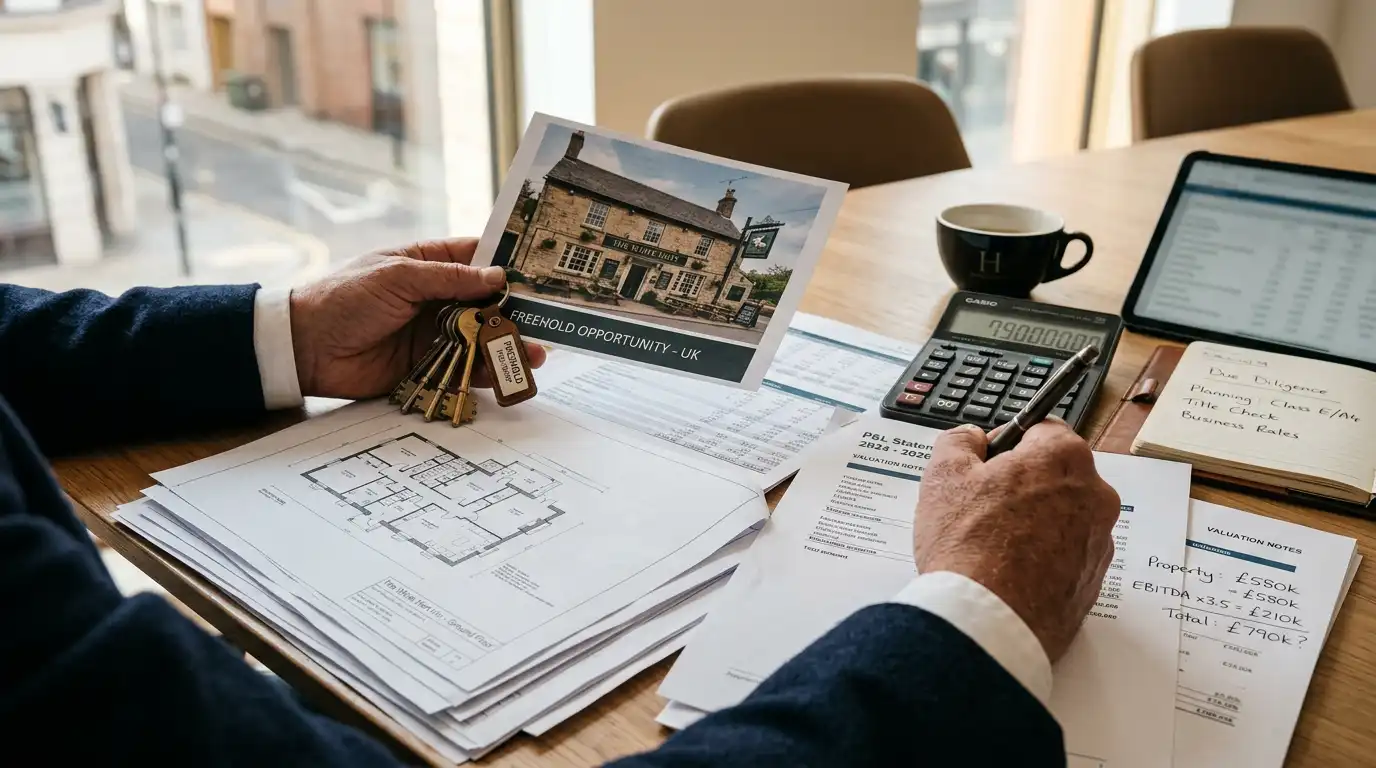
Freehold cafes are a different purchase entirely, typically £250,000 to £750,000 outside London and well above that in prime city positions, priced as property plus a modest business value. Our guide to freehold businesses for sale covers how that changes the financing.
What the fit-out is actually worth. A full cafe fit with a commercial espresso machine, grinders, counter, refrigeration, extraction and seating costs £60,000 to £150,000 new. A three-year-old fit-out has real value, and buying one at a discount to replacement cost is a legitimate reason to pay a premium. Check the equipment isn't on lease, because leased equipment doesn't transfer automatically. Espresso machines in particular are often on finance.
Our business valuation guide walks through normalising earnings before you apply any multiple.
A note on these numbers. The UK has no published dataset of small business asking prices or transaction multiples: neither ONS nor any regulator collects them. The ranges above are drawn from current listings on the main UK marketplaces and from how brokers price this sector, so treat them as a sense-check on whether an asking price is sane, not as a valuation. The only numbers that matter for your deal are the ones in the seller's accounts.
The 2025-26 cost squeeze, and why it matters to a buyer
If you're buying a cafe using accounts from 2024, you're modelling a business that no longer exists. Three things moved hard.
Employer National Insurance. The April 2025 changes raised the employer NI rate and lowered the secondary threshold. Hospitality employs a lot of part-time staff on relatively low hours, so the threshold change bit far harder here than in higher-wage sectors. UKHospitality has been vocal about it precisely because the sector's cost base is so labour-weighted.
National Living Wage. Successive above-inflation rises have lifted the floor for the majority of cafe staff hours. Baristas, kitchen assistants and front-of-house are mostly at or near the wage floor, so every uprating flows almost directly into the P&L.
Green coffee prices. Arabica hit multi-year highs on the back of Brazilian weather problems, tracked by the International Coffee Organization. Roasters passed increases through, and most cafes absorbed part of it rather than repricing fully. Wholesale coffee costs are a smaller share of the P&L than wages, but the increase landed in the same period as everything else.
Then there's business rates. Retail, hospitality and leisure relief has been repeatedly extended at varying percentages, and its future is decided budget by budget. A cafe with a high rateable value in a town centre faces a genuine step change if relief is reduced. Check the rateable value against the Valuation Office listing and model the bill without relief. If the business only works with relief, it doesn't work.
What to do with all this as a buyer:
- Rebuild the wage bill at today's National Living Wage and today's employer NI, not the seller's historic figure.
- Get the current coffee supply contract and check the price and the term.
- Model business rates at full liability as a downside case.
- Check when the energy contract ends.
- Look at whether the cafe has raised prices. Many haven't, out of fear, and that's actually your opportunity rather than a problem.
Here's the thing about a cost squeeze: it lowers prices for buyers. Sellers who've watched their margin erode for three years are motivated, and businesses with fixable cost problems get discounted as if the problems were structural. Some are. Plenty aren't.
Due diligence: separating a business from a lease with a coffee machine
The generic checks in our due diligence checklist apply. These are the ones specific to cafes.
Get the till data, not the accounts. A modern EPOS records transactions by hour, by day, by product. Ask for twelve months. You want the daily pattern (is it a 7am commuter trade or an 11am brunch trade?), the weekly pattern, the seasonal swing, and the average transaction value. Cash-heavy cafes with vague records should be valued on card takings only.
Sit in the shop. Two weekdays and a Saturday, counting customers and watching what they order. It's the single most useful thing you can do, and almost nobody does it. Compare your count with the till data.
The lease is most of the deal. Unexpired term, rent, review pattern, service charge, break clauses, repairing obligations, and whether the landlord will consent to assignment. Anything under six years unexpired materially limits what you can finance and what you can sell it for later. A rent review due next year on an under-rented site is a large hidden liability.
Check the planning use and any restrictions. Hours of opening, extraction, external seating, A-boards and licensing for alcohol if the cafe trades into the evening. External seating on the pavement needs a licence from the highway authority and it can be withdrawn.
Food hygiene rating. Public and free to check. A 5 tells you the kitchen is run properly. A 2 or 3 is a red flag about the operation generally, not just the kitchen.
Staff. Who's employed, on what terms, and who's staying? A cafe where the head barista and the chef both leave on completion is a much weaker business than the accounts suggest. TUPE applies to an asset sale, so you inherit the contracts whether you want them or not.
Equipment condition and ownership. Espresso machine service history, refrigeration age, extraction cleaning certificates. And check what's on lease.
The competition, including what's coming. A new Gail's, Black Sheep or Costa opening two doors down changes everything. Planning applications are public.
One question worth asking directly: why is the owner selling? The honest answers in this trade are usually retirement, relocation, health, or exhaustion. The last one is common and it isn't disqualifying, but it does tell you the business demands more than the seller could give it.
A worked example: the numbers on a high street cafe
This worked example is an illustrative composite built from typical market figures, not a record of a specific transaction. Use it as a method for taking a deal apart, and run your own numbers on any business you actually look at.
Here's a deal taken apart. A leasehold cafe on a market town high street, 34 covers plus four outside, asking £95,000 premium. Seven years unexpired at £24,000 a year.
The seller's pitch. "£8,400 a week. Good business, I just can't do the hours any more."
The rebuild, from twelve months of EPOS data:
| Line | Annual | Notes |
|---|---|---|
| Turnover | £436,800 | £8,400 a week, confirmed on till data |
| Cost of sales at 31% | £135,400 | Drinks 68% of sales, food 32% |
| Wages, 4.5 FTE, at 2026 rates | £158,000 | Rebuilt, not taken from the accounts |
| Rent | £24,000 | Review due in 18 months |
| Rates after RHL relief | £6,800 | £19,400 without relief |
| Energy, insurance, card fees, waste | £41,200 | |
| Repairs, marketing, sundries | £14,300 | |
| Owner's earnings (SDE) | £57,100 | Owner works 5 days on the floor |
At £95,000 that's 1.7x SDE. Looks fine. Then three adjustments.
One: the wage bill. The seller's accounts showed £141,000. Rebuilt at current National Living Wage and April 2025 employer NI, the same rota costs £158,000. That £17,000 difference is not a negotiation point, it's arithmetic, and it's already in the table above.
Two: the rent review. Due in 18 months, on a site the agent thought was £4,000 to £6,000 under market. Assume £5,000. SDE falls to about £52,000.
Three: business rates relief. If relief were withdrawn the bill rises £12,600. That's the downside case, and it would take SDE to about £39,000. Worth knowing, not worth pricing in fully.
And the upside nobody had touched. Prices hadn't moved since early 2024. A 7% increase across the menu on a business with 69% gross margin adds roughly £30,000 of gross profit, and in this trade a well-communicated rise of that size very rarely costs meaningful volume. The cafe also closed at 3pm, in a town with no evening coffee offer at all.
Where it lands. Around £52,000 of adjusted SDE, a fixable pricing problem, a real rent risk, and a downside case that's survivable. At 1.75x adjusted earnings that's about £91,000, so the asking price was roughly fair rather than a bargain. The deal only makes sense if you're confident about the price increase, which means it's a deal for an operator rather than an investor.
That's the honest summary of most cafe purchases in the UK. You're buying a job with an asset attached, and the return depends on whether you're better at running it than the person selling.
What a new owner should change first
The good news about buying a tired cafe is that the fixes are usually cheap and fast.
Raise prices. Independent cafes are chronically under-priced because owners fear losing regulars. On a 75% gross margin product, a 40p rise on a £3.80 flat white is close to pure profit. Do it once, do it properly, print new menus, and don't apologise for it.
Extend the trading day. Most independents close between 3pm and 4pm because the owner has been there since 6am. If the town has no evening offer, staying open until 7pm with a simpler menu uses a fit-out and a lease you're already paying for.
Fix the food attachment rate. What proportion of drinks customers also buy food? If it's 25%, getting it to 40% through better display, better prompting and a decent bakery supplier lifts average spend without a single extra customer.
Sell the beans and the merchandise. Retail bags of coffee, reusable cups, a subscription. Small money, good margin, and it makes the shop feel like a brand rather than a room.
Look at wholesale and catering. Supplying nearby offices, delivering to local businesses, catering for meetings. It fills the flat mid-morning and mid-afternoon periods.
Get the ordering and waste under control. Cost of sales at 30% versus 34% is worth £17,000 a year on a £437,000 turnover. Waste in food-led cafes is where money quietly disappears, and it's a management problem rather than a capital one.
Rethink the rota against the till data. Most cafes are overstaffed at 2pm and understaffed at 9am. The EPOS hourly report tells you exactly where, and rota changes cost nothing.
If you need to fund a purchase plus a refresh, read our guide to financing a business purchase in the UK first. Lenders are cautious about hospitality, so expect to bring a meaningful deposit and to be asked about your operating experience.
Should you buy a coffee shop in the UK?
Only if you're going to run it. That's the honest answer, and it's the one most sellers won't give you.
Coffee shops are the most emotionally attractive business in this series and the most operationally demanding. The margin on the product is superb. The margin on the business is thin, because labour and rent eat it. The difference between a cafe that makes £60,000 and one that loses money is almost entirely the owner's presence, pricing discipline and rota management.
The case for buying one is real. Demand is growing, the branded market has expanded five years running, and there's genuine value in buying a fitted-out site with a customer base for less than the fit-out cost alone. Plenty of independent cafes are under-priced, under-marketed and closed by mid-afternoon, and those are all fixable.
The case against is that this is a hospitality business with hospitality risks: staff turnover, waste, weather, a rent review you don't control, and a business rates regime decided budget by budget.
Where I'd look: a coffee-led site with a strong morning trade, a lease over seven years, an owner who's tired rather than failing, prices that haven't moved in two years, and a fit-out under five years old. That combination comes up regularly and it's usually priced on the seller's exhaustion.
Where I'd walk: any cafe where the turnover multiple is doing the valuation work, sites with under five years of lease, brunch-led operations where the chef is leaving, and anything that only works with business rates relief.
Before you offer:
- Get twelve months of EPOS data by hour, day and product.
- Sit in the shop for three days and count.
- Rebuild the wage bill at current wage and NI rates, then test the adjusted profit in our UK business valuation calculator.
- Have a solicitor read the lease, especially the review clause and repairing obligations.
- Check the rateable value and model the rates bill without relief.
You can browse businesses for sale on NewOwner, including hospitality listings across London, London, and Bristol, to compare cafes and coffee shops listed directly by their owners. The business buyer starter kit covers comparing deals consistently, and you can read about our verification process or get in touch if you want a second view on a specific site.