- What "freehold" actually means for a UK business sale
- Why freehold deals matter in 2026
- The main types of freehold business for sale in the UK
- How to value a freehold business deal
- What to look for and what to avoid
- How buyers actually finance freehold deals
- How to find a good freehold business for sale in the UK
A freehold business for sale UK buyers chase is usually two deals stitched together. The trading business is one. The bricks the business sits on is the other. Each has its own value, its own risks, and its own buyer pool. Most people I talk to undervalue one and overpay for the other.
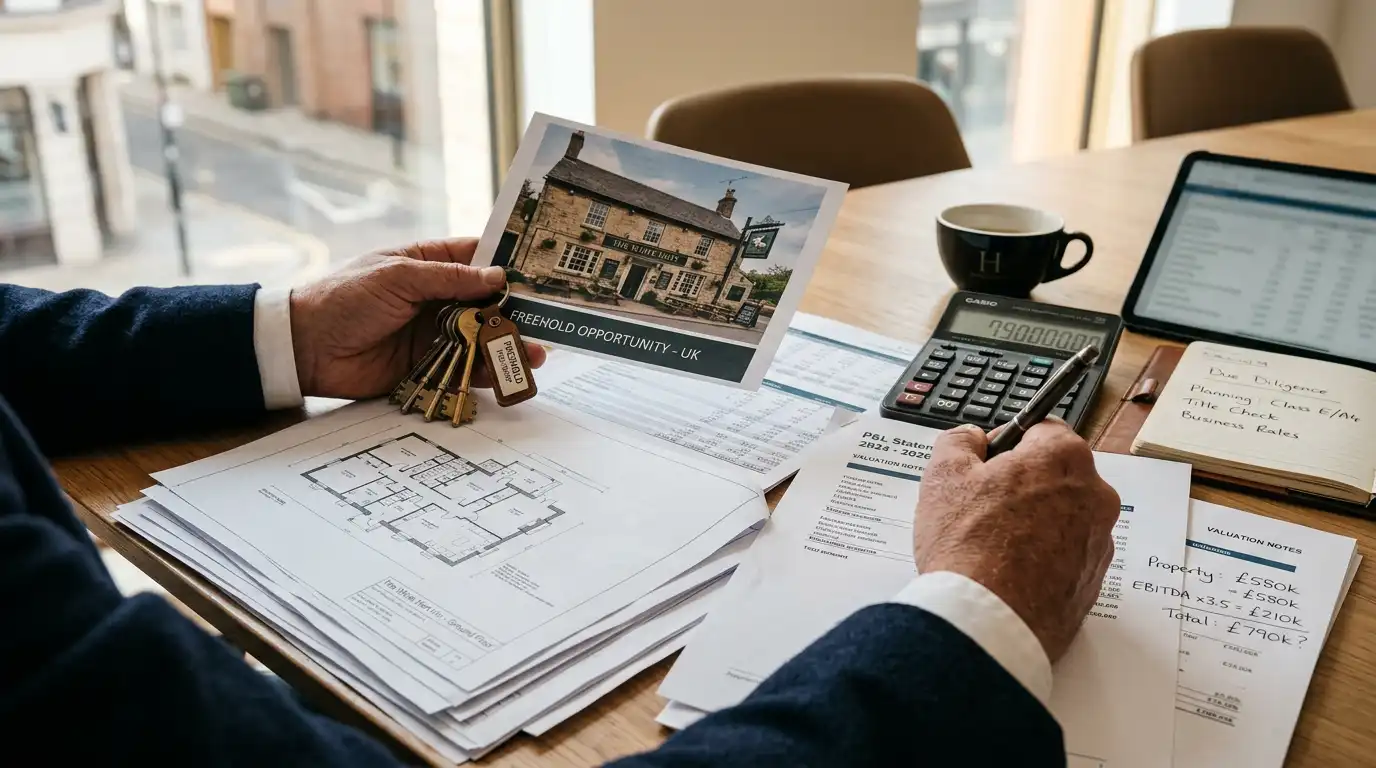
I spent last quarter looking at three freehold deals: a Yorkshire freehold pub at £625K, a Brighton freehold cafe at £390K, and a small freehold light-industrial unit in the West Midlands at £840K. Two of those numbers were defensible. One was a fantasy. This piece is how I tell them apart, the maths I run before I make an offer, and what UK buyers should genuinely care about when they see "freehold" in a listing title.
If you want to skip the theory and go straight to live deals, browse freehold businesses for sale on NewOwner. The rest of this article is for buyers who want to understand what they're looking at before they pick up the phone to a seller.
What "freehold" actually means for a UK business sale
Freehold means you own the land and the building outright, with no rent payable to a landlord. In a business sale, the freehold sits with the trading entity (or a separate property co.) and transfers to the buyer at completion. The buyer ends up owning two things: the business and the premises it operates from.
Contrast that with the alternatives you'll see in UK SME listings:
- Leasehold. You're buying the business and the lease. Rent is payable to a landlord, lease has a term (typically 5-25 years), and there are usually break clauses, rent reviews and dilapidations to plan around.
- Freehold + leaseback. Some sellers retain the property and lease it back to the buyer for 15-25 years. You only buy the trading business. Lower upfront, but you take on long-term rent.
- Mixed estate. The trading group owns some freeholds and leases others. Common in regional pub estates and multi-site retail.
For a buyer, the practical difference is huge. With a freehold you control the premises, capture any property appreciation, and avoid lease renewal risk. With a leasehold you put less capital in but you live with whatever the landlord decides at the next rent review.
When sellers describe a deal as a "freehold business for sale" they usually mean the full freehold transfers with the trading business. Always confirm this in writing before due diligence starts. I've seen "freehold" listings turn out to be long leaseholds dressed up in marketing copy. If the title at the Land Registry isn't a registered freehold, it's not a freehold deal.
Why freehold deals matter in 2026
Three things changed for UK freehold business buyers between 2022 and 2026.
First, interest rates settled higher than the post-2008 norm. Borrowing against commercial property is more expensive than it was, which has pushed yields up and asking prices down. Vendor flexibility on freehold-only valuations is real for the first time in years.
Second, the pub and hospitality sector went through a sustained shake-out. A wave of distressed freehold pubs hit the market in 2023-2024 as tenanted-pub-co groups rationalised estates. Many were bought by individual operators or small consortia at meaningful discounts to 2019 valuations. That wave is mostly through, but the pricing reset stuck.
Third, planning rules around change of use (notably Class E) made some freeholds more flexible than the same building was five years ago. A high-street retail freehold can now often be re-used as office, gym, light leisure or service without full planning permission. That changes the downside scenario on a deal, because if the trade fails, you still own a useful building.
The net effect for a 2026 buyer: freeholds are more interesting on a risk-adjusted basis than they've been since the post-2008 dip. The trick is paying the right price for the building and a sensible multiple for the business, not lumping them together at a number that flatters the seller.
The main types of freehold business for sale in the UK
Different freehold business categories trade at different multiples and have very different risk profiles. Here's what comes up most often.
Freehold pubs and restaurants
The biggest single category in UK freehold business listings. A community freehold pub doing £450K turnover and £85K EBITDA typically trades for £450K-£650K depending on region and condition. The pricing logic splits into trade goodwill (1-2x EBITDA) plus the property value, often the dominant component.
What to check: alcohol licence status, the kitchen condition, accommodation rooms upstairs (often the swing factor in valuation), and whether the freehold includes the car park. Always read the licence personal-licence holder requirements before assuming the trade transfers cleanly.
Freehold cafes and coffee shops
Usually smaller tickets (£200K-£500K). The freehold is often a ground-floor shop unit with a flat or two above. Buyers underestimate how much of the deal value is in the residential flats. A freehold cafe with two let flats above can have £150K of annual gross rental income alongside the trade, which materially changes the IRR.
Freehold retail and convenience stores
Freehold convenience stores and small supermarkets trade at 1.5-2.5x annual net profit on the trade side, with the freehold valued separately at investment yields of 6-8% on the rental equivalent. A SPAR or independent c-store doing £700K turnover and £75K net might be £400K for the trade plus £250K-£350K for the freehold, depending on location.
If this category interests you, the deeper breakdown is in our supermarket and convenience store for sale UK guide.
Freehold light industrial and trade premises
Manufacturing units, joinery workshops, MOT centres, vehicle repair workshops. The property usually dominates the deal because the building has alternative-use value to other trade businesses. For a focused look at trade-business deals see the joinery and trade business buyer's guide.
Freehold workshops in industrial estates near major roads have been one of the more resilient UK property categories since 2020 because of e-commerce fulfilment demand pushing up secondary industrial values.
How to value a freehold business deal
The single biggest mistake I see buyers make is treating a freehold business as one valuation. It's two.
Step 1: value the trade business as if it had no premises
Start with normalised EBITDA. Strip out the owner's salary if they're operationally involved (or normalise to a market salary). Strip out any non-recurring costs. Add back rent at a notional market rate for the premises, because if you owned the freehold, you'd technically be paying yourself rent. This gives you a normalised EBITDA you can multiply.
For a UK small business with established trade, a fair multiple is 2.5x-4x normalised EBITDA. The full method is in our normalised EBITDA guide.
Step 2: value the property independently
Three common methods:
- Investment yield method. If the building were let to a third party at market rent, what would it yield? Apply the regional commercial yield (6-9% for most secondary UK locations) and gross up. Building worth £200K means market rent of £14K-£18K, suggesting £200K-£225K value.
- Comparable sales. What have similar freehold shops, pubs or units in the area sold for in the last 12-24 months? Land Registry data is free and public.
- Replacement cost. What would it cost to build the same square footage in the same location, less depreciation. Useful as a sanity check, not a primary method.
Use two methods, take the lower number, and that's your defensible property value.
Step 3: add and check against the asking price
Trade business value + property value = your defensible offer. Compare to asking. If the asking is more than 15% above your number, you have a negotiation. If it's more than 30% above, the seller hasn't taken advice and there's likely either an information gap or a deal-killer somewhere in the data.
Worked example. Freehold cafe, asking £450K. Trade: £45K normalised EBITDA at 3x = £135K. Property: 60 sqm shop + 2 flats at £210K (shop) + £90K (flats) = £300K. Defensible offer £435K. Asking £450K. Negotiate to £420K-£435K and shake hands.
What to look for and what to avoid
Specific things I check on every freehold business deal before going past indicative offer:
- Title at HM Land Registry. Pull the title plan and register entries. Confirm freehold status, identify any restrictive covenants, charges, easements or rights of way. A solicitor will do this properly during due diligence, but the £3 title pull is something I do before making an offer.
- Lease for any part of the premises. Some deals look freehold but have a flat upstairs let on an AST, or a yard let to a neighbouring business. Those tenancies transfer with the freehold.
- Building condition. Roof, electrics, gas safety, fire safety. A £15K-£40K capex hit in year one will wreck a small deal's IRR. Always commission a full building survey before exchange.
- EPC rating. Commercial premises in England and Wales must meet MEES (Minimum Energy Efficiency Standards). From April 2027 the rating threshold rises to B. Pubs and older retail freeholds often sit at D or E and will need investment.
- Planning history. Has the building been refused planning for change of use? That's a flag. Has it been granted permitted-development rights? That's an opportunity.
- Trading history vs property history. Sometimes the trade is mediocre but the freehold is undervalued because the seller priced it as an operating business rather than as a property asset. That's where alpha lives.
Things to avoid:
- Freeholds where the seller wants to retain part of the building (yards, flats, parking). The split title often kills the deal in legals.
- Pubs subject to long-running tied-tenancy buy-out disputes. These have legal complexity that takes years to unwind.
- Properties with a single specialist use (e.g. a purpose-built kennels) where alternative-use value is low. You're betting entirely on the trade continuing.
How buyers actually finance freehold deals
Freehold deals are easier to finance than leaseholds, because the bank has a tangible asset to secure against. Typical structure for a £500K freehold business deal:
- Commercial mortgage on the property. 60-70% LTV against the property valuation. Lenders include high street banks (NatWest, HSBC) and specialist commercial lenders (Cambridge & Counties, Allica, Shawbrook). Rates in 2026 are running 6.5-8.5% for owner-occupier commercial property.
- Buyer equity. 25-40% deposit. Mix of cash and SIPP/SSAS pension assets is common for buyers in their 50s and 60s.
- Seller financing or earn-out. Often 10-25% of the trade goodwill portion, paid over 2-3 years tied to trading performance.
- Working capital facility. Separate small overdraft or invoice finance facility for the trade.
If you don't have the deposit, the financing options narrow considerably. The how to buy a business with no money in the UK guide covers seller-finance and earn-out structures in detail.
A SIPP-funded property purchase is worth investigating if you have £200K+ in pension assets. The pension fund buys the freehold, the trading business pays rent to the pension. Done properly it's tax-efficient. Done badly it triggers HMRC penalties. Use a SIPP provider with experience in commercial property purchases and a solicitor who specialises in pension-fund property work.
How to find a good freehold business for sale in the UK
Sources, in rough order of deal flow quality for a UK buyer with £200K-£1M to deploy:
- Direct marketplaces. Freehold listings on NewOwner, including property-backed businesses across Leeds, Birmingham, and Leeds. You talk to the seller directly, filter by sector and price.
- Specialist sector brokers. Christie & Co for pubs and hospitality, Adams & Wilkes for hospitality and retail, Eddisons for industrial and trade.
- Auction houses. Allsop and SDL Auctions list distressed freehold commercial regularly. Sub-30-day completion. Useful for cash buyers.
- Local solicitors and accountants. Particularly in regional markets. They hear about owner-retirement situations months before anything reaches the open market.
- Direct approach. If there's a specific freehold pub or shop you want, write to the owner. About 1 in 10 will reply. Of those, maybe 1 in 4 will engage. Slow but yields off-market opportunities.
For most buyers I'd start with direct marketplaces and one specialist broker for the sector you're focused on. Layer in solicitor relationships once you've been actively looking for 3-6 months and have a clear thesis.
If you're new to the buying process altogether, the step-by-step UK buyer's guide for 2026 walks through the full deal sequence. Benchmark the trading component in our UK business valuation calculator, structure your diligence with our Business Buyer Starter Kit and our platform verification standards, and read how to analyse a business before buying it alongside this guide.