- How We Ranked These Sectors
- Best Small Businesses to Buy UK 2026: Sector Comparison at a Glance
- Top 10 Small Businesses to Buy in the UK (2026)
- 1. Convenience Stores
- The owner-salary trap
- 2. Independent Pubs & Gastropubs
- 3. Care Homes & Domiciliary Care Agencies
- 4. E-commerce & Dropshipping Brands
- Online business due diligence is different
- 5. Vending Machine Routes
- 6. MOT Garages & Auto-Service Shops
- Browse hundreds of verified UK businesses for sale
- 7. Accountancy & Bookkeeping Practices
- 8. Children's Nurseries (OFSTED-registered)
- 9. Coffee Shops & Cafes
- London business buyers: what actually sells
- 10. SaaS & Digital Agencies
- Where to Find Small UK Businesses for Sale in 2026
- How to Evaluate a Small Business Before You Buy
- Financing a Small Business Acquisition in the UK
- Which Small Business Should You Actually Buy in 2026?
Starting a business from scratch is harder than it looks on Instagram. You're guessing at demand, building a customer base from nothing, and funding it out of your own pocket for longer than anyone admits in the success stories. Buying one of the best small businesses to buy UK sellers bring to market is the alternative, and in 2026 it's a genuinely good one.
Over 400,000 UK businesses with directors aged 60 or over are expected to change hands in the next five years, according to ONS Business Demography data and research from the Federation of Small Businesses. Many are perfectly healthy companies being sold simply because the owner wants to retire. That's your opportunity: proven revenue, existing customers, and a motivated seller.
NewOwner, a UK marketplace for the best small businesses to buy UK investors are actively targeting, has analysed 2,500+ deals to track where buyers are finding value and where they're getting burned. This guide ranks 10 sectors by what matters most to a buyer: EBITDA multiple, capital required, recession resilience, and the honest risks most listicles gloss over.
If you're researching the best small businesses to buy UK-wide or searching for a small business for sale UK buyers actually trust, the sector you choose will matter more than almost any other decision you make. Start here.
Read the complete guide to buying a business in the UK alongside this if you're at the research stage.
How We Ranked These Sectors
Every sector in this best small businesses to buy UK ranking was scored on five factors:
- EBITDA multiple range: what buyers are actually paying in 2025-26 UK deal data, not theoretical benchmarks
- Typical entry ticket: total capital required including professional fees and working capital buffer
- Barriers to entry: how hard it is to run this type of business without specialist background
- Recession resilience: how each sector performed during the 2020 Covid shock and the 2022-23 cost-of-living squeeze
- Deal availability: how many live listings appear on UK marketplaces at any given time
A note on multiples: small UK businesses (EBITDA under £200k) trade at 2.5x–5x EBITDA. The UK mid-market average EV/EBITDA was 5.3x in H1 2025 according to Dealsuite's UK M&A Monitor, but most owner-managed small businesses sell at the lower end of that range. Quality and transferability of revenue push multiples up; owner-dependency and concentration risk pull them down.
None of these sectors is a guaranteed winner. Each one has a trap for the buyer who doesn't do proper due diligence, and I've flagged them honestly below.
Quick tip: When shortlisting the best small businesses to buy UK-wide, rank by recession-resilient cash flow first, headline multiple second. A 3.5x EBITDA accountancy practice will outperform a 6x leisure business in a downturn every time, regardless of what the sticker price implies.
Best Small Businesses to Buy UK 2026: Sector Comparison at a Glance
Before diving in, here's how the 10 best small businesses to buy UK-wide in 2026 stack up side by side. Use this as a shortlist filter — entry ticket, typical EBITDA multiple, weekly workload and scalability all move the decision more than headline yield.
| # | Sector | Entry ticket | Typical EBITDA multiple | Net margin | Owner workload | Scalability |
|---|---|---|---|---|---|---|
| 1 | Convenience stores | £60k–£350k (leasehold) | 2x–4x | 3–6% | High (60–70 hrs/wk) | Medium (multi-site) |
| 2 | Independent pubs & gastropubs | £150k–£1m+ | 4x–7x | 8–14% | High | Low |
| 3 | Care homes & domiciliary care | £300k–£2m+ | 5x–8x | 10–18% | Medium (manager-led) | High |
| 4 | E-commerce & DTC brands | £30k–£500k | 2x–4x (or 1x–3x revenue) | 8–20% | Low–Medium | High |
| 5 | Vending machine routes | £20k–£150k | 2x–3x | 15–25% | Low (semi-passive) | High (add machines) |
| 6 | MOT garages & auto-service | £80k–£400k | 2.5x–4x | 10–18% | Medium | Medium |
| 7 | Accountancy & bookkeeping | £100k–£800k | 1x–1.5x recurring fees (~4x–7x EBITDA) | 25–40% | Medium | Medium–High |
| 8 | Children's nurseries (OFSTED) | £150k–£1.5m | 4x–7x | 8–15% | Medium (manager-led) | Medium |
| 9 | Coffee shops & cafes | £40k–£300k | 1.5x–3x | 4–10% | High | Low |
| 10 | SaaS & digital agencies | £50k–£2m+ | 3x–8x (SaaS); 3.5x–5x (agencies) | 20–40% | Low–Medium | High |
Figures are 2026 UK SME ranges based on NewOwner deal data and published market benchmarks. Owner workload assumes owner-operated; manager-led structures reduce hours but also reduce EBITDA available to the buyer.
Top 10 Small Businesses to Buy in the UK (2026)
Here's the full breakdown, sector by sector.
1. Convenience Stores
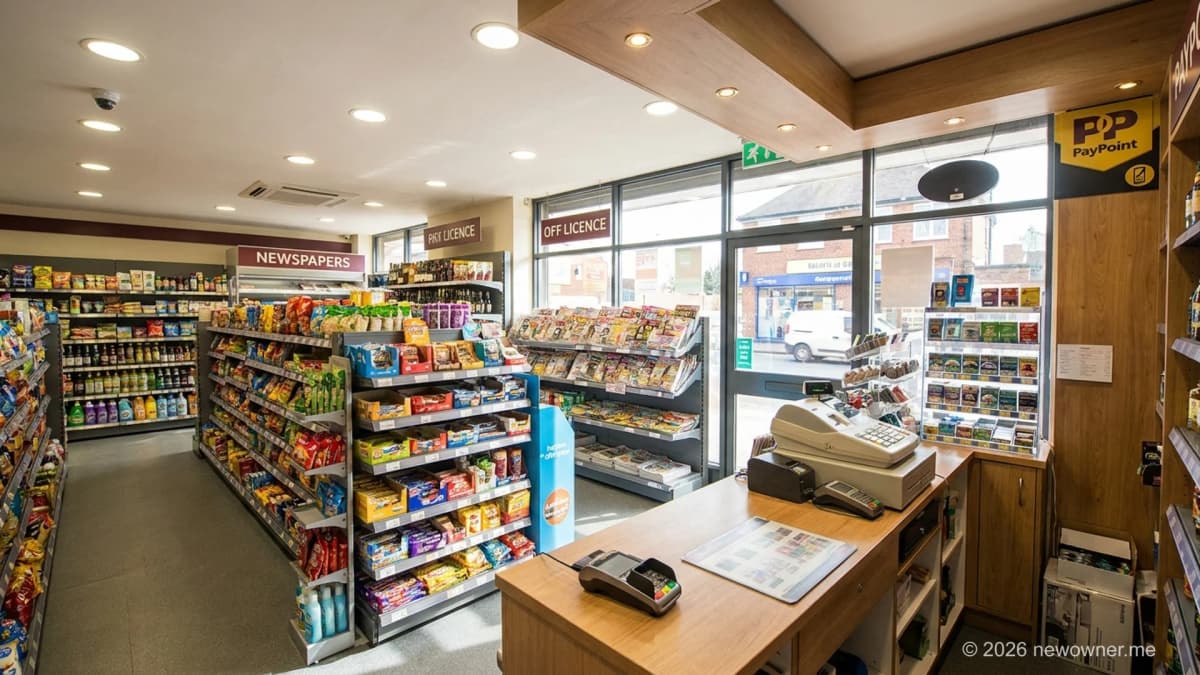
Convenience stores consistently top the shortlist of best small businesses to buy UK first-time buyers consider, because they're the most accessible entry point. There are around 50,000 convenience stores operating in the country, and a steady flow of them comes to market each year as owner-operators retire or relocate.
The fundamentals are simple: you're buying a recurring footfall business with relatively predictable cash flows. Weekly turnover at an owner-managed convenience store ranges from £5,000 to £27,000+ depending on location and product mix, with gross margins of around 20–28%. The lease is the biggest variable.
Key numbers
EBITDA multiple: 2x–4x net profit (leasehold), higher for freehold with property Entry ticket: £60,000–£350,000 leasehold; up to £800,000+ for freehold with strong turnover Capital required: Budget at least 30% equity; the rest can be financed
Pros and cons
Pros: Predictable cash flow, relatively straightforward operations, strong succession inventory, cash-generative from day one
Cons: Long hours are standard (many are open 6am–11pm), staff turnover is high, margins are squeezed by competition from supermarket express stores
Who should buy this
Ideal buyer: A hands-on buyer willing to be present in the business, ideally with some retail or operations experience. Not a good choice if you want a passive income from day one.
Watch out for
The trap: Buying a store where turnover is inflated by the owner not paying themselves properly. Always normalise the accounts. If the owner works 70 hours a week and doesn't appear on the payroll, those earnings need replacing.
Heads up: Among the best small businesses to buy UK-wide, convenience stores have the highest ratio of asking price to actual transferable profit. Roughly 40% of listings we see overstate normalised EBITDA by £15k-£40k once owner labour is properly costed. Factor this in before you make an offer.
See live convenience store businesses for sale on NewOwner, including London listings.
The owner-salary trap
In many small businesses, convenience stores especially, the seller's 'profit' figure includes unpaid or under-paid owner labour. If the seller works 60 hours a week at minimum wage, that's over £25,000 a year in hidden cost. Always normalise EBITDA before comparing to the asking price. Our normalised EBITDA guide explains how.
2. Independent Pubs & Gastropubs
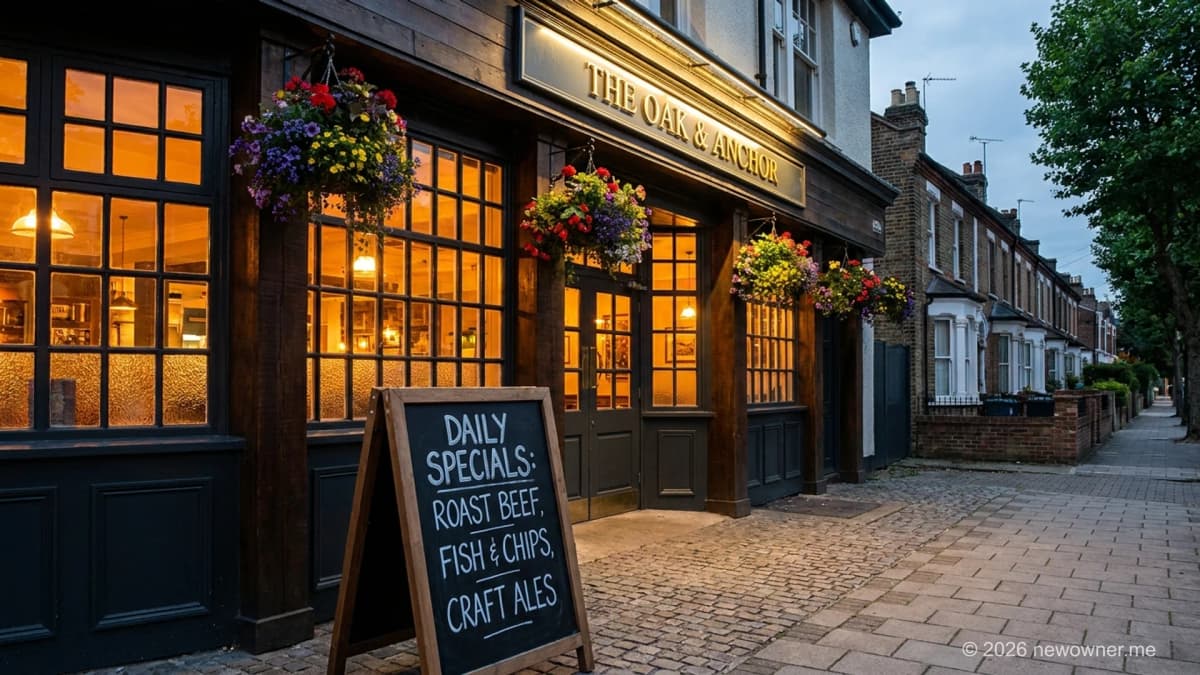
Pubs are polarising. On any best small businesses to buy UK list, they divide readers more than any other sector. Some buyers romanticise them. Others have been burned by them. The honest reality is somewhere in the middle: a well-run, food-led community pub or gastropub can be an excellent acquisition, but the sector has real structural headwinds that you can't ignore.
The UK pub market was worth £24.9bn in 2026 (IBISWorld), and wet-led pubs in particular have seen active M&A consolidation; Admiral Taverns' estate was valued at an implied 8.2x EBITDA multiple in 2025. That reflects a portfolio premium that individual pub buyers won't see.
Key numbers
EBITDA multiple: 4x–7x for leasehold operations; tied pubs trade differently (EBITAV rather than EBITDA) Entry ticket: £150,000–£1,000,000+ depending on lease terms, property ownership, and food-led vs wet-led Capital required: Substantial. Budget for working capital, initial stock, and potentially refurbishment
Pros and cons
Pros: Strong community anchoring creates loyal repeat trade, food-led operations can hit better margins, freehold pubs hold underlying property value
Cons: Rising labour costs (National Living Wage increases hit hospitality hard), energy costs are structural not cyclical, business rates can be punishing in urban locations
Who should buy this
Ideal buyer: Someone with genuine hospitality experience, or a buyer partnering with an experienced operator. This isn't a sector to learn on the job.
Watch out for
The trap: Tied pub agreements. If you're buying a tenancy rather than a freehold, check the tie terms carefully. You may be obligated to buy beer at prices well above the open market, destroying your margin. Get a solicitor experienced in tied-pub leases.
Browse pubs and hospitality businesses for sale on NewOwner to see current listings.
3. Care Homes & Domiciliary Care Agencies
If recession-proofing is your priority, care sits near the top of any credible best small businesses to buy UK list and is the closest thing to a guaranteed market. The UK's ageing population means demand for residential care and at-home care services is structurally increasing. The ONS projects the 85+ population to more than double by 2045. That demographic inevitability makes care businesses attractive to institutional buyers, which pushes up multiples.
Care homes and domiciliary (at-home) care agencies are distinct businesses. Residential care homes are capital-intensive, heavily regulated, and property-led in their valuation. Domiciliary care agencies have lower capital requirements but face intense competition and thin margins.
Key numbers
EBITDA multiple: 5x–8x for residential care homes (well-rated, 90%+ occupancy); 3x–5x for domiciliary agencies Entry ticket: £300,000–£2,000,000+ for a small residential care home; £80,000–£300,000 for a domiciliary agency Capital required: Substantial equity required; specialist lenders (Christie Finance, Healthcare Finance) are more active than generalist banks
Pros and cons
Pros: Genuinely recession-proof, long-term contracts with local authorities or NHS, strong barriers to entry via CQC registration
Cons: CQC regulation is demanding. A 'Requires Improvement' rating can destroy the business value overnight. Staff shortages in social care are acute, and rota management is a constant operational challenge.
Who should buy this
Ideal buyer: Buyers with a clinical, operations, or management background in health and social care. A first-time buyer without sector experience will struggle with CQC requirements.
Watch out for
The trap: Buying on occupancy that was artificially high before sale. Request rolling 12-month occupancy data, not just the snapshot at point of listing.
4. E-commerce & Dropshipping Brands
E-commerce now earns a permanent spot on the best small businesses to buy UK map. The online business for sale market in the UK has matured considerably. What was once a cottage industry of flipped Shopify stores has become a legitimate acquisition category, with buyers ranging from micro-acquirers spending £30,000 to PE-backed roll-ups spending £10m+.
E-commerce businesses are valued on a revenue multiple (1x–3x annual revenue) or EBITDA multiple depending on profitability. A dropshipping operation with £200,000 turnover and £40,000 net profit might sell for £80,000–£160,000. A branded DTC (direct-to-consumer) brand with owned SKUs, a strong email list, and repeat purchase rates above 30% commands more. Sometimes 3x–5x EBITDA.
Key numbers
EBITDA multiple: 2x–4x EBITDA (or 1x–3x revenue for high-growth, low-profit brands) Entry ticket: £30,000 for a basic dropshipping operation; £200,000–£500,000 for an established branded store Capital required: Lower than most brick-and-mortar options. No lease, and no stock if dropshipping.
Pros and cons
Pros: Location-independent, no physical premises required, clean financials (Stripe/Shopify data is highly verifiable), easily scalable
Cons: Platform dependency risk is real. If you're 80% Amazon and Amazon changes the algorithm, you've got a problem. Traffic quality (organic vs paid) is everything.
Who should buy this
Ideal buyer: Digital natives or anyone with performance marketing experience. If you can't read a Google Analytics dashboard or a Meta ads account, you'll be relying entirely on whoever you hire.
Watch out for
The trap: Traffic that looks good but doesn't convert. Always request read-only access to Google Analytics and Search Console, not screenshots. Actual access. Verify that traffic is owned (email list, SEO) not just rented (paid ads).
Browse online businesses for sale on NewOwner. We list verified e-commerce and digital businesses with audited financials.
Online business due diligence is different
When buying an online business for sale in the UK, your due diligence checklist looks different from a bricks-and-mortar deal. You need read-only access to Google Analytics, Search Console, Stripe/PayPal, and the ad accounts. Check for algorithm dependency, supplier concentration, and whether the brand assets (domain, social accounts, trademarks) are actually owned by the company, not the founder personally. Read our full business analysis guide for the complete checklist.
5. Vending Machine Routes
Vending is one of the most overlooked entries on any best small businesses to buy UK list, partly because it doesn't feel like a 'real' business, though it absolutely is. A well-established vending machine route, a portfolio of machines placed in offices, leisure centres, schools, and transport hubs, can generate £60,000–£150,000 net profit with very limited owner involvement once the route is established.
The UK vending market is dominated by a handful of large operators, but there's a substantial tail of small, owner-managed routes that come to market regularly. These businesses have very low capital intensity (the machines are already placed and earning), predictable recurring revenue from placement contracts, and no staff headaches.
Key numbers
EBITDA multiple: 2x–3x net profit Entry ticket: £20,000 for a small route; £80,000–£150,000 for an established multi-location route Capital required: Low. This is one of the few sectors where buyers with under £100,000 can acquire something genuinely income-generating.
Pros and cons
Pros: Semi-passive income, low overheads, scalable by adding machines, no premises required, targets the KD 0 keyword niche on Google
Cons: Machine maintenance requires either skill or contractor relationships, placement contracts need renewal, and cash handling is still common (though card-enabled machines are standard now)
Who should buy this
Ideal buyer: A buyer wanting a manageable side acquisition or a first stepping stone. Also suits anyone looking to build a portfolio of income-generating assets rather than one big business.
Watch out for
The trap: Machines that look profitable but are sitting in declining locations: offices with falling headcount, leisure centres with lapsing memberships. Verify placement contract terms and renewal dates before buying.
Search for vending machine businesses for sale on NewOwner.
6. MOT Garages & Auto-Service Shops
Cars don't stop needing servicing in a recession — which is exactly why MOT garages feature on every best small businesses to buy UK ranking we track. MOT garages and general auto-service shops are among the most recession-resilient businesses you can buy in the UK. The service isn't optional, and switching costs for customers who've found a trusted mechanic are high.
The sector has another tailwind: the UK's EV transition is slower than government targets suggest, which means petrol and diesel servicing demand stays strong well into the 2030s. Shops that have added basic EV diagnostics capability are ahead of the curve without having pivoted away from bread-and-butter work.
Key numbers
EBITDA multiple: 2.5x–4x normalised EBITDA Entry ticket: £80,000–£400,000 (leasehold), much higher for freehold workshop with equipment Capital required: Equipment-heavy businesses can secure asset finance against machinery post-completion
Pros and cons
Pros: Reliable recurring revenue from repeat servicing, relatively transferable (customers stick to the location not the owner), MOT test certification adds switching-cost protection
Cons: DVSA licensing and MOT authorisation aren't automatically transferable. The new owner needs their own. This causes deal delays that buyers don't always anticipate.
Who should buy this
Ideal buyer: Either someone with automotive background or a buyer who intends to hire a qualified manager from day one. The technical credibility with existing customers matters.
Watch out for
The trap: Buying a shop where the MOT authorisation is personal to the seller. Your solicitor should flag this, but confirm the transfer process with DVSA before exchange.
Browse hundreds of verified UK businesses for sale
NewOwner lists the best small businesses to buy UK buyers want, across every sector: from convenience stores and cafes to online businesses and professional practices. Every listing includes financials, sector data, and direct seller contact.
7. Accountancy & Bookkeeping Practices
Accountancy practices are the textbook example of a sticky, recurring-revenue business and a perennial feature in any best small businesses to buy UK shortlist. Once a client is with an accountant, they rarely leave. The hassle of switching outweighs the benefit, and the relationship can run for decades. That stickiness makes practices highly predictable businesses to buy and operate.
The practice acquisition market is booming. As of 2025, smaller practices (£1m–£8m fee income) were commanding multiples of 1x–1.5x annual recurring fees, with premium practices in high-demand locations trading higher. According to Bains & Watts, 2026 represents a potential plateau. The frenzy of 2022–24 is cooling, which is actually good news for buyers who've been priced out.
EBITDA multiple / fee multiple: 1x–1.5x annual recurring fees (equivalent to roughly 4x–7x EBITDA) Entry ticket: £100,000 for a small sole-trader practice; £500,000–£800,000 for an established multi-partner firm Capital required: Many practice sales involve seller financing. The buyer pays a portion upfront and the remainder over 2–4 years out of client retention
Pros and cons
Pros: Genuine recurring revenue (annual accounts, payroll, VAT returns), inflation-linked fee growth, low capital intensity, clients are sticky
Cons: Client retention post-sale depends heavily on the handover. If the seller disappears immediately, clients may follow. Key-person risk is high.
Who should buy this
Ideal buyer: Qualified accountants looking to own a practice rather than work in one, or acquisition-minded firms adding client books. Non-accountants struggle because clients expect technical conversations.
Watch out for
The trap: Buying on headline fee income without verifying retention. Request a client list with fee history for three years. How many clients have left in the past 24 months? What was the reason?
8. Children's Nurseries (OFSTED-registered)
Childcare is structurally undersupplied in the UK, which is why it has become one of the best small businesses to buy UK investors are bidding on hardest. Government expansion of funded childcare hours (15–30 hours per week for under-5s) has increased demand while supply has lagged, meaning well-run nurseries with OFSTED 'Good' or 'Outstanding' ratings are trading at strong multiples and attracting competitive bidding.
Christie & Co reported a 3.8% increase in average nursery sale prices in 2025, with large group operators dominating (62% of deals) but first-time buyers still active (21% of completions). That tells you two things: there's institutional appetite (validating the investment case) and there's still room for individual buyers.
Key numbers
EBITDA multiple: 4x–7x for 'Good'/'Outstanding' rated nurseries; distressed or 'Requires Improvement' rated businesses trade at heavy discounts Entry ticket: £150,000 for a small leasehold nursery; £800,000–£1.5m for an established setting with freehold Capital required: Healthcare/childcare lenders are more active here than generalist banks
Pros and cons
Pros: Government-backed fee income (funded hours provide a revenue floor), strong demand-supply imbalance, OFSTED barrier to entry deters casual competition
Cons: OFSTED ratings can change. A rating drop from 'Good' to 'Requires Improvement' will hit both occupancy and eventual sale price. Staff ratios are non-negotiable by law, making labour cost management rigid.
Who should buy this
Ideal buyer: Early years educators moving into ownership, or investors willing to hire an experienced nursery manager. The regulatory environment is not forgiving of amateur management.
Watch out for
The trap: Buying on occupancy rates without checking the underlying funded-hours vs private-pay mix. Funded hours are income-capped; private-pay sessions give you pricing flexibility. The split matters for margin.
Browse childcare and education businesses for sale on NewOwner.
9. Coffee Shops & Cafes
Right, let's be honest about this one. Of all the best small businesses to buy UK buyers research, coffee shops are the sector most people romanticise and most quickly regret. The margins are thin, the hours are brutal, and the competition from chains is relentless in most UK high streets. That said, there's a genuine category of cafe business worth buying, and it looks nothing like the generic city-centre espresso bar.
The businesses worth considering are destination cafes with a clear niche (artisan bakery, specialty coffee with direct trade, brunch-focused) with strong Google reviews, and a customer base that isn't dependent on passing trade alone. London cafes are a particular target for buyers searching 'businesses for sale London', but urban rents can swallow margin entirely.
Key numbers
EBITDA multiple: 1.5x–3x EBITDA (leasehold); very rarely higher unless the brand has exceptional defensibility Entry ticket: £40,000–£300,000 depending on lease terms, equipment, and location Capital required: Low entry price is offset by working capital needs. Expect to invest in the fit-out and stock.
Pros and cons
Pros: Low entry cost relative to other sectors, community loyalty for well-established independents, food-led cafes with evening trading can improve margins considerably
Cons: The sector has the highest failure rate of any on this list. Lease renewals are a common killer. A landlord who knows you're profitable can dramatically increase rent at renewal.
Who should buy this
Ideal buyer: Someone who already has hospitality management experience, not someone who loves coffee and thinks it'll translate. This is a lifestyle business category where operational discipline separates the survivors from the casualties.
Watch out for
The trap: Buying in a location where the footfall depends on a specific anchor tenant: a large office, a cinema, a university. If that anchor changes, your revenue follows it.
Find cafe and coffee shop businesses for sale on NewOwner, including London listings.
London business buyers: what actually sells
Among the best small businesses to buy UK capital-city buyers target, London listings attract premium prices but also the deepest buyer pool in the UK. The sectors with the best value-to-competition ratio in London right now are: convenience stores in Zone 2-4 residential areas, domiciliary care agencies, and accountancy practices with a London-based client book. Coffee shops in central London are genuinely difficult to make work at the rents landlords are demanding.
10. SaaS & Digital Agencies
Among the best small businesses to buy UK-wide in 2026, SaaS is the category that has reset hardest. The frothy ARR multiples of 2021–22 are gone. As of March 2026, the median EV/Revenue multiple for SaaS sits at 3.4x, down sharply from peaks above 10x. For small bootstrapped SaaS with modest growth, expect 3x–5x ARR. For a growing B2B SaaS with good metrics (NRR above 110%, churn below 2%), buyers are still paying 4x–8x ARR.
Digital agencies are a different proposition. They're people businesses with recurring retainer contracts rather than true software revenue. Creative and digital agencies trade at 3.5x–5x adjusted EBITDA, with premium valuation for agencies that have genuine proprietary methodology or a dominant niche.
This is where NewOwner connects with the investments side of the market. SaaS acquisitions attract investors rather than owner-operators.
Key numbers
EBITDA multiple: 3x–8x ARR for SaaS; 3.5x–5x EBITDA for agencies Entry ticket: £50,000 for a micro-SaaS; £500,000–£2m+ for an established agency with meaningful recurring revenue Capital required: Variable; SaaS can be acquired with personal capital, agencies need substantial working capital
Pros and cons
Pros: Location-independent, high margins for well-run SaaS, agency recurring retainers provide predictability, talent is the main asset so no inventory or property risk
Cons: Key-person risk in agencies is extreme. If two senior people leave post-acquisition, you've lost a large chunk of the value you paid for. SaaS faces AI disruption risk that's accelerating, not receding.
Who should buy this
Ideal buyer: Technical founders, digital marketers, or investors with experience managing professional services teams. These aren't passive investments.
Watch out for
The trap: In agencies, buying on EBITDA that includes the founder's 'market salary' at zero or artificially low. A founder running a £2m agency and paying themselves £50k is not showing you real profitability.
Explore digital and tech businesses on NewOwner or browse investment opportunities.
Where to Find Small UK Businesses for Sale in 2026
Once you have picked a sector from the best small businesses to buy UK shortlist above, the next question is where to actually find live deals. Most buyers start and finish their search on the big marketplaces. That's fine. It's where the majority of UK small businesses for sale are listed. But there are faster routes too.
Online marketplaces: NewOwner, Rightbiz, Daltons, BusinessesForSale.com, and BizSale all aggregate listings from brokers and direct sellers. NewOwner focuses on verified listings with transparent financials, which matters if you want to avoid time-wasters. alongside the broader platforms.
Business brokers: Specialist brokers (Christie & Co, Turner Butler, Hilton Smythe, regional independents) have off-market deals and pre-qualified buyer-seller introductions. They earn their fee from the seller, so using them costs you nothing.
Direct outreach: Identifying businesses in your target sector and approaching owners directly does work, especially for businesses not yet thinking about a sale. A professional, respectful approach, not a cold spam, occasionally surfaces the best deals, because there's no competitive bidding process.
Accountants and solicitors: Both regularly know of clients considering an exit before any listing is made. If you're serious about buying a business in a specific sector, building relationships with sector-specialist advisers is worth the investment of time.
For a detailed comparison of UK marketplaces by deal type and buyer profile, see how to compare UK business-for-sale marketplaces.
Regional demand snapshot
The best small businesses to buy UK buyers are chasing vary by region. The table below is a directional snapshot of where particular sectors sell fastest and at what multiples in 2026.
| Region | Hottest sectors | Typical EBITDA multiple | Sale velocity |
|---|---|---|---|
| London and South-East | SaaS, digital agencies, childcare | 4–7x | Fast |
| Midlands | MOT garages, manufacturing, accountancy | 3–5x | Medium |
| North of England | Care homes, hospitality, convenience | 3–5x | Medium |
| Scotland | Hospitality, care, trades | 2.5–4.5x | Slower |
| Wales and South-West | Hospitality, e-commerce, tourism-adjacent | 2.5–4x | Slower |
Owner-operated freeholds and regulated sectors (nurseries, care homes, accountancy) attract the widest pool of buyers and move fastest.
How to Evaluate a Small Business Before You Buy
Every one of the best small businesses to buy UK ranked above has a version of the same core evaluation process. Before making any offer on a UK business for sale, you need to verify:
Financial verification: three years of accounts, VAT returns, bank statements. Do the numbers reconcile across all three? Most fraudulent or misleading sellers get caught here if you actually check.
Normalised EBITDA: strip out the owner's personal expenses run through the business, any one-off costs or revenues, and the market-rate salary that would need replacing if the owner leaves. The resulting number is what you're actually buying. Read our normalised EBITDA guide before you start.
Revenue transferability: how much of the revenue depends on the current owner's personal relationships? High owner-dependency is the most common reason acquisitions underperform. If the owner is the business, the business doesn't survive the handover.
Concentration risk: what percentage of revenue comes from the top three customers? More than 40% from a single customer is a meaningful risk. More than 60% is a red flag.
Lease and licence terms: what happens to the lease, licences, and main contracts when ownership changes? Change-of-control clauses in commercial leases have tripped up many buyers.
For a complete pre-purchase checklist, the how to check a UK business before you buy guide walks through financial, legal, and commercial due diligence in detail.
Financing a Small Business Acquisition in the UK
Most buyers don't pay cash. Financing the best small businesses to buy UK sellers list tends to follow a standard structure: equity (your own money), debt (bank or alternative lender), and a seller loan note covering 10–20% of the price.
For businesses priced under £500,000, the main financing routes are:
- Personal equity (30–50% of purchase price): lenders want skin in the game
- Commercial loans: Barclays, HSBC, NatWest, and Lloyds all have SME acquisition teams; expect rates of 6–9% above base on 5–7 year terms
- British Business Bank Growth Guarantee Scheme: government-backed lending through accredited lenders, useful where conventional banks won't go
- Seller financing: common below £1m; the seller takes a loan note paid from future earnings, which aligns incentives during the handover period
The British Business Bank's Finance Hub has a tool to match your deal profile to suitable lenders, which is a reasonable starting point if you're not sure where to go.
For acquisitions involving limited personal capital, see the guide to buying a business with no money in the UK for seller financing structures and creative deal arrangements.
Which Small Business Should You Actually Buy in 2026?
Here's the honest answer: the best small businesses to buy UK buyers should actually pursue are the ones that match your skills, your capital, and your tolerance for operational involvement, not the sector with the highest EBITDA multiple on paper.
If you want recession-proof income and have healthcare experience, care or nurseries are compelling. If you want a hands-on operational business with a straightforward model, convenience stores and vending machine routes offer genuine value at accessible price points. If you're digital-native and want to work from anywhere, an online business for sale in the UK, e-commerce or SaaS, removes the lease and location risk entirely.
Pubs and coffee shops are sectors where I'd urge caution unless you have genuine hospitality experience. The romanticised version of running a gastropub is very different from the reality of managing staff on a Bank Holiday weekend when two people called in sick and your delivery didn't arrive.
NewOwner lists verified small businesses for sale across the UK: from London convenience stores to Scottish care agencies to remote-friendly online businesses. Use the sector analysis above to narrow your search, then use proper due diligence to validate what you find.
Buying the right business, in the right sector, at the right price is one of the best financial decisions you can make in 2026. Buying the wrong one is expensive in ways that go well beyond money. Take your time with the research, and start your search on NewOwner.
Key fact: Across the best small businesses to buy UK-side in 2026, the single strongest predictor of buyer return is not sector — it's revenue recurrence. A business where 60%+ of annual revenue renews automatically outperforms a higher-multiple, higher-churn business in almost every scenario.
Ready to sell your business?
Get Started