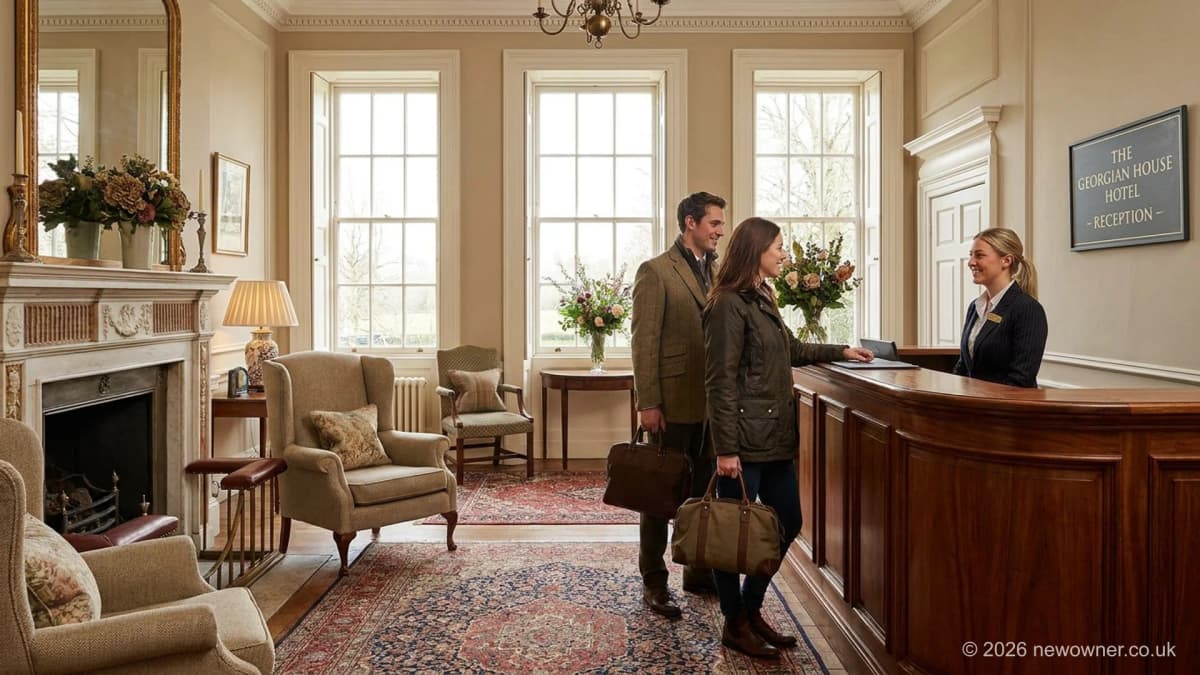
UK hotel transactions range from regional boutique properties at £375,000 to prime institutional London assets exceeding £17,000,000.
- The UK hotel acquisition market
- Hotel business for sale: key operating metrics
- Freehold versus leasehold: capital structure and risk for your hotel acquisition
- Deferred refurbishment: the FF&E reserve and physical capex
- Franchise agreements and Hotel Management Agreements (HMAs)
- Food, beverage, and events: profit driver or operational liability?
- Hotel business for sale: valuation benchmarks and transactional pricing
- Pre-acquisition due diligence and funding roadmap for a hotel for sale UK
The UK hotel acquisition market
Hotel acquisitions in the United Kingdom are one of the most operationally intensive and capital-heavy asset classes in commercial property. If you are searching for a hotel for sale UK, inventory on NewOwner spans a wide valuation band: from provincial 12-bedroom boutique coaching inns priced around £375,000 up to prime institutional central London freehold hotels marketed at £17,000,000.
While our previous guides explored smaller lifestyle assets like B&Bs and guest houses or fractional hotel room investments, acquiring an entire hotel is a totally different undertaking. You aren't simply purchasing real estate or passive yield; you are taking control of a complex operational hybrid combining 24/7 accommodation, food and beverage operations, event licensing, facilities management, and an extensive staff payroll under the Transfer of Undertakings (Protection of Employment) Regulations (TUPE).
In 2026, the sector is defined by operational divergence across key geographic territories. Regional leisure hubs (such as the Lake District, Cornwall, the Cotswolds, and the Scottish Highlands) enjoy strong summer average room rates but face severe shoulder-month drops and staffing pressures worsened by local housing shortages. In contrast, commercial provincial city centres like Manchester, Birmingham, and Leeds benefit from balanced corporate midweek trade alongside weekend concert and sporting demand. Central London is a distinct tier entirely, where international inbound flight volumes support year-round occupancy above 80%, insulating prime operators from broader domestic economic contractions.
Assets that rely heavily on third-party Online Travel Agencies (OTAs) with neglected physical infrastructure face severe margin compression from rising utility and labour overheads. Conversely, well-positioned regional boutique hotels with high direct-booking ratios, alongside branded corporate hotels with reliable conference demand, continue to deliver strong commercial yields and long-term asset appreciation.
Hotel business for sale: key operating metrics
Underwriting a hotel requires looking past headline turnover to evaluate the four universal trading metrics that govern hospitality cash flow.
1. Occupancy percentage
Occupancy measures the proportion of available rooms sold across a given period (annual, seasonal, or monthly). In the UK, a healthy annual occupancy benchmark sits between 72% and 82% for London properties, and 65% to 75% for provincial and resort hotels. However, an annual figure can obscure extreme seasonal volatility. A coastal or countryside hotel running at 92% occupancy in July and August may drop to 32% in January. During due diligence for a hotel acquisition, demand monthly room night schedules to calculate winter operational cash burn and test whether summer cash surpluses are enough to service winter debt payments. Consider referencing data from STR's hospitality benchmarking to contextualize performance.
2. Average Room Rate (ARR) / Average Daily Rate (ADR)
ARR calculates the average realised revenue per paid occupied room:
$$\text{ARR} = \frac{\text{Total Room Revenue}}{\text{Total Number of Occupied Rooms}}$$
Examine the composition of ARR. A hotel reporting an ARR of £120 may be achieving £180 on Saturday night weddings while giving away midweek corporate rooms at £65 through opaque OTA discounting. Scrutinise distribution channel costs: an ARR of £110 booked directly through the hotel website yields roughly £106 net of card fees, whereas the same £110 booking via Booking.com or Expedia incurs a commission between 15% and 22%, reducing the net room revenue to under £90.
3. Revenue Per Available Room (RevPAR)
RevPAR is the single most critical operational indicator in the hotel sector because it balances occupancy against room rate:
$$\text{RevPAR} = \text{Occupancy Rate} \times \text{ARR} = \frac{\text{Total Room Revenue}}{\text{Total Available Rooms}}$$
| Hotel Metric | Budget / Limited-Service | Regional Boutique / 3-Star | Upscale / 4-Star London |
|---|---|---|---|
| Annual Occupancy | 74% – 82% | 66% – 75% | 76% – 85% |
| Average Daily Rate (ADR) | £55 – £85 | £95 – £145 | £190 – £310 |
| RevPAR Range | £42 – £70 | £65 – £108 | £150 – £260 |
| OTA Commission Share | 20% – 35% | 25% – 45% | 15% – 30% |
| GOPPAR Benchmark | £18 – £32 | £28 – £52 | £75 – £130 |
4. Gross Operating Profit Per Available Room (GOPPAR)
While RevPAR measures top-line room generation, GOPPAR measures bottom-line operational efficiency by dividing total hotel departmental profit (rooms, dining, bar, conferences) minus operational expenses by the total available rooms. A high RevPAR driven by excessive marketing spend, heavy housekeeping agency overtime, or lavish guest amenities will produce a poor GOPPAR, indicating a business that works hard for its lenders and suppliers rather than its equity owners.
Freehold versus leasehold: capital structure and risk for your hotel acquisition
The division between freehold and leasehold ownership determines your financing options, operational freedom, and long-term exit security.
The freehold hotel model
Freehold ownership gives the acquirer full title to the land and buildings. Across the UK hospitality business sector, freehold is the preferred structure for both institutional investors and private operators for distinct reasons:
- Senior debt availability: Commercial lenders (like Barclays, NatWest, and specialist hospitality funds) will lend up to 55%–65% Loan to Value (LTV) on freehold hotels based on Red Book property valuations. Lenders view the real estate as tangible security, lowering interest margins.
- Operational resilience: In low-season trading dips or during broader economic downturns, a freehold operator doesn't have a landlord threatening forfeiture. If net operating income falls, the owner must service debt interest but isn't trapped by an escalating commercial rent obligation.
- Value-add development: Freehold owners retain absolute control over planning applications, such as adding guest bedrooms, converting outbuildings into spas, adding EV charging infrastructure, or repurposing grounds for luxury glamping lodges.
The leasehold hotel model
Leasehold hotels trade at much lower entry prices than freeholds, frequently at a 60% to 75% discount for equivalent room counts. This allows buyers to acquire large operations with modest initial equity. However, the commercial risks are substantial:
- Upward-only rent reviews: Most institutional hotel leases (frequently 25 to 35-year terms) mandate upward-only rent reviews every five years, tied to RPI or Open Market Value. In periods of inflationary cost pressure, an inflexible lease rent can wipe out the hotel's entire net margin.
- Tenant covenants and alienation restrictions: Assigning a hotel lease requires landlord consent. Landlords demand strict financial covenant checks, and many leases prohibit sub-letting food and beverage outlets or spa facilities to independent operators.
- Dilapidations and full repairing covenants: Hotel leases are almost universally Full Repairing and Insuring (FRI). At lease expiry or assignment, landlords can serve substantial terminal dilapidations claims running into hundreds of thousands of pounds for historic building fabric defects, lift servicing backlog, or roof repairs.
Deferred refurbishment: the FF&E reserve and physical capex
Nothing destroys the investment thesis of a hospitality business acquisition faster than unaccounted-for physical deterioration. When examining financial statements, understand that historic cash flow was frequently achieved by the vendor deferring essential capital expenditure on furniture, fixtures, and equipment (FF&E).
The standard 3% to 5% FF&E reserve
In institutional hotel management accounting, an operator must set aside 3% to 5% of gross revenue annually into a dedicated FF&E escrow reserve. This cash fund isn't discretionary profit; it is the capital required to replace mattresses every 5–7 years, recarpet guest corridors every 6 years, update soft furnishings, replace smart TVs, and refurbish commercial laundry and kitchen machinery.
When evaluating independent, family-run hotels, you will often find that no FF&E reserve was ever maintained. The reported net profit was artificially inflated because the vendor extracted cash rather than reinvesting in the asset. When you step into ownership, you inherit an asset suffering from design fatigue, worn casegoods, and dated bathrooms that depress your review scores on Google and TripAdvisor.
Critical physical audit lines
Prior to finalising purchase contracts, commission a specialist Building Survey and MEP (Mechanical, Electrical, and Plumbing) condition report covering:
- Boilers, calorifiers, and heating systems: Replacing a commercial hotel boiler plant servicing 30 to 60 bedrooms is a complex six-figure capital project that can disrupt guest occupancy for weeks. Verify water pressure balance across upper floors during morning peak usage.
- Air conditioning and ventilation (HVAC): Verifying compliant refrigerants, F-Gas logbooks, and servicing certificates for all split units and air handling plants. In historic listed buildings, retrofitting air conditioning is often heavily constrained by conservation planning officers.
- Water hygiene and Legionella compliance: Review the statutory Legionella Risk Assessment (LRA) and temperature monitoring logs under the Health and Safety at Work etc. Act 1974. Large calorifiers with dead legs in older piping represent an immediate liability. You should verify standards via the Health and Safety Executive (HSE) guidelines.
- Passenger and service lifts: Inspect the current Thorough Examination report under the Lifting Operations and Lifting Equipment Regulations 1998 (LOLER). Modernising an obsolete commercial passenger lift typically costs between £45,000 and £80,000 per shaft.
- Fire safety compliance: The Fire Safety (England) Regulations 2022 and Regulatory Reform (Fire Safety) Order 2005 impose strict statutory duties. Inspect the fire risk assessment, automatic door closers, fire alarm panel records, and emergency lighting test certificates. Upgrading non-compliant fire doors across a 40-bed hotel costs upwards of £40,000.
- Roofing and external envelope: Flat roofs, parapets, and masonry lintels on historic country house or Regency town house hotels represent substantial long-term maintenance commitments that generalist surveyors often overlook.
Hotel technical due diligence decision gates
| Inspection Area | Statutory Audit Verification | Commercial Deal Remedy |
|---|---|---|
| Commercial Boilers & HVAC | Condition report on heating plant, calorifiers, and F-Gas compliant air-handling units. | Capital Deduction: If central boiler plant exceeds 10 years or requires replacement, deduct £50,000–£120,000 from the offer price. |
| Fire Safety & LOLER Lift Certs | Fire Safety Order 2022 compartmentation assessment, fire door ratings, and LOLER lift certificates. | Pre-Completion Undertaking: Require the vendor to remediate all category-one fire safety defects prior to exchange. |
| Franchise Brand PIP Mandate | Official franchisor Property Improvement Plan (PIP) inspection audit report. | Contract Escrow: Hold back full agreed PIP capital sum (£5,000–£20,000 per key) in legal escrow to fund post-sale brand compliance. |
Franchise agreements and Hotel Management Agreements (HMAs)
Acquiring a branded hotel involves a three-way legal relationship between the asset owner (the buyer), the brand franchisor, and the operational management team.
Hotel franchises (Accor, IHG, Marriott, Best Western)
Buying an existing franchised hotel provides instant access to global distribution engines, corporate loyalty programmes, and central reservation systems. However, franchisors impose strict contractual conditions:
- Property Improvement Plans (PIPs): Upon a change of ownership, franchisors almost universally issue a mandatory PIP inspection. This document outlines every element of the hotel that must be upgraded to comply with current brand standards (e.g., brand-specific bed linen, signage, smart TV casting, breakfast buffet counters). A PIP usually demands £5,000 to £20,000 per room key in immediate post-completion capital expenditure.
- Franchise Fee Structure: Royalties typically range from 4% to 6% of gross rooms revenue, supplemented by a 2% to 4% marketing assessment fee and technology distribution charges (e.g., £3–£6 per booking delivered via central reservations).
Hotel Management Agreements (HMAs)
If you intend to buy a hotel UK as a passive or semi-passive investment, you will likely operate under an HMA with a professional white-label management company (such as Interstate, Cycas, or Kew Green). Under an HMA, the operator runs all day-to-day services. This includes hiring staff, setting room pricing algorithms, and managing procurement. The owner supplies the capital and covers operating costs.
- Base Management Fees: Typically 2.0% to 3.5% of total gross hotel revenue.
- Incentive Management Fees: Calculated as 8% to 12% of Adjusted Gross Operating Profit (AGOP) after debt service, aligning the operator's incentives with bottom-line profitability.
- Performance Tests: Ensure the HMA contains a robust operator performance test. If the management company fails to achieve at least 85% of the agreed RevPAR benchmark or approved annual budget for two consecutive years, the owner must retain the unilateral right to terminate the agreement without penal exit fees.
Worked financial comparison: Franchise vs HMA vs Independent
| Financial & Operating Metric | Global Franchise (50-Key) | White-Label HMA (50-Key) | Independent Boutique (50-Key) |
|---|---|---|---|
| Gross Hotel Revenue | £1,600,000 | £1,450,000 | £1,300,000 |
| Operating Expenses (F&B, Staff, Utilities) | -£960,000 (60.0%) | -£870,000 (60.0%) | -£780,000 (60.0%) |
| Brand Royalty / Management / OTA Fees | -£136,000 (8.5% Franchise fee) | -£79,750 (5.5% HMA fee) | -£128,700 (18% on OTA bookings) |
| FF&E Capital Replacement Reserve (4%) | -£64,000 | -£58,000 | -£52,000 |
| Net Operating Income (NOI) | £440,000 (27.5%) | £442,250 (30.5%) | £339,300 (26.1%) |
| Operational Governance Profile | Semi-passive (GM supervised) | Turnkey passive (HMA operated) | Owner-operator intensive |
Food, beverage, and events: profit driver or operational liability?
For independent and country house hotels, weddings, private dinners, conferences, and destination restaurants represent a major component of turnover. However, revenue doesn't equal margin.
While room accommodation routinely delivers 75% to 85% departmental profit margins, food and beverage operations run on thin, volatile margins of 15% to 25% due to high culinary labour ratios, inventory perishability, and food cost inflation. When evaluating a hotel's accounts:
- Separate departmental revenue: Demand separate P&L schedules for Rooms, Food, Beverage, and Conferencing. If a hotel turning over £1.5m generates £900k in food and beverage and £600k in rooms, it is fundamentally a high-risk catering business with bedrooms attached.
- Wedding and advance deposit liabilities: In country house hotels, customer deposits for future weddings and functions can exceed £100,000 to £250,000. These funds belong to the clients until the event takes place. In a share purchase, ensure these advance deposits are fully funded in cash within completion accounts rather than treated as historical trading cash already spent by the vendor.
Hotel business for sale: valuation benchmarks and transactional pricing
UK hotels are valued primarily through two methodologies: Net Yield / Capitalisation of Sustainable Operating Profit (EBITDA) for trading assets, and Price Per Room Key as a market comparability cross-check.
| Hotel Category | Average Price Per Key | Capitalisation Yield (EBITDA Multiple) | Target Investor Profile |
|---|---|---|---|
| Provincial Coaching Inn (10–20 keys) | £30,000 – £55,000 | 11.0% – 14.0% (7.0x – 9.0x) | Owner-operators, regional lifestyle buyers, boutique hospitality entrepreneurs. |
| Regional Commercial 3-Star (30–70 keys) | £55,000 – £95,000 | 9.0% – 11.5% (8.5x – 11.0x) | Multi-unit hotel operators, regional investment syndicates, corporate franchisees. |
| Country House / Wedding Venue (20–50 keys) | £80,000 – £160,000 | 8.5% – 10.5% (9.5x – 12.0x) | Event specialists, boutique luxury groups, high-net-worth family offices. |
| Central London Boutique (25–80 keys) | £250,000 – £600,000+ | 5.5% – 7.5% (13.0x – 18.0x) | Institutional funds, international hotel groups, sovereign wealth and family capital. |
When applying EBITDA multiples, ensure the earnings figure is properly adjusted. Strip out private director emoluments, add back legitimate one-off legal fees, but ensure you deduct a full commercial management charge if the business was previously managed hands-on by an owner-proprietor.
Pre-acquisition due diligence and funding roadmap for a hotel for sale UK
Securing a successful hotel completion demands a disciplined legal, commercial, and financial roadmap. This is especially true when closing on a hotel for sale UK.
- Commercial Debt Financing: Engage specialist commercial hospitality brokers early. Lenders require three years of certified accounts, a formal RICS Red Book valuation, a detailed business plan, and proof that the management team possesses direct hotel operational experience. Review our financing guide on how to finance buying a business in the UK for acquisition loan frameworks.
- Staffing and TUPE Verification: Request the Employee Liability Information (ELI) audit early. Hotels employ a diverse workforce across reception, housekeeping, night audit, kitchen, and facilities. Audit minimum wage compliance (including sleep-in shifts and accommodation offsets), holiday accruals, and foreign national sponsorship licences under current UK immigration rules.
- Licensing and Statutory Permissions: Check the Premises Licence for live conditions (live music curfews, outdoor drinking permissions, wedding ceremony civil approval). Verify environmental permits for commercial septic tanks or private water boreholes in rural locations.
- Transaction Structure: Work through our analysis on due diligence checklists and our Business Buyer Starter Kit, test the trading EBITDA in our UK business valuation calculator, and study whether to proceed via a trade and asset acquisition or a share purchase. In share sales, review our guidance on company debt and liabilities to safeguard against historic tax audits or unresolved guest claims.
Browse active hotels and commercial hospitality businesses for sale on NewOwner—including prime hospitality assets in London, Bristol, and Scotland—and read about our verification methodology to compare current listing yields and regional asking valuations.