- Selling a business in 2027: where the UK market stands
- Share sale, asset sale, MBO or EOT: four ways to sell a business
- How to sell a business in the UK in 8 steps
- How much does it cost to sell a business in the UK?
- How long does it take to sell a business? A 2027 timeline
- Tax on selling a business: BADR at 18% with a worked example
- New rules for 2027 sellers: Companies House ID checks and employment law
- Who is buying UK businesses in 2027
- Broker or marketplace: where to sell my business
- Common mistakes when selling your business
- How to sell a business in 2027: your next step
Selling a business in the UK means transferring either your company's shares or its assets and goodwill to a buyer under a binding sale agreement, then paying tax on the gain. That's the definition. How to sell a business well is the harder part, and for a sale completing in 2027 it comes down to eight steps: value it, prepare it, plan the tax, pick a route to market, package it, find and qualify buyers, negotiate heads of terms and due diligence, then complete.
Most owner-managed businesses take 6 to 12 months from launch to completion, with 3 to 6 months of preparation before that. Start in the last quarter of 2026 and a realistic completion date lands in the 2027/28 tax year.
The rules have moved, too. Business Asset Disposal Relief (BADR) now charges 18% on qualifying gains made from 6 April 2026. Every director and person with significant control (PSC) has to verify their identity with Companies House. And the Employment Rights Act 2025 changes how buyers price staff risk, with its biggest step on 1 January 2027.
At a glance, October 2026: Bank Rate 3.75% after the 17 September decision. BADR 18% on up to £1m of lifetime gains. A typical sale runs 6 to 12 months once you're on the market. The Budget on 28 October 2026 may move the tax figures, so check anything tax-related against gov.uk before you sign.
If you already know you want out, you can list your business on NewOwner and talk to buyers directly. The rest of this guide is about doing it without leaving money behind.
Planning your UK business exit? Keep 100% of your sale price
List directly to verified UK buyers for £99/mo with 0% completion commission, or request a confidential 48-hour investor buyout offer on £1M+ companies.
Selling a business in 2027: where the UK market stands
Market conditions don't change how to sell a business. They do decide who's buying and how hard the buyer's lender pushes. The table shows the position as at October 2026, with a source for every figure.
| Indicator | Latest figure | Date | Source |
|---|---|---|---|
| Bank Rate | 3.75%, held by a 6-3 vote (three members voted for 4%) | 17 Sep 2026 | Bank of England September 2026 summary |
| CPI inflation | 3.1% | Aug 2026 | Bank of England |
| CPI outlook | About 3.75% in Q4 2026, slightly above 4% in Q1 2027 | Sep 2026 | Bank of England |
| UK M&A deals announced | 1,301, down 13% year on year | H1 2026 | PwC mid-year M&A outlook |
| UK M&A deal value | £124.2bn, more than double a year earlier | H1 2026 | PwC |
| Gross SME bank lending | £68bn, up 9% | 2025 | British Business Bank, March 2026 |
| Median UK SME EBITDA multiple | 4.5x, down from 5.5x | Nov 2025 | UK200Group and MarktoMarket SME index |
| Next Budget | 28 October 2026 | Confirmed 31 Jul 2026 | HM Treasury letter to the Treasury Committee |
What the numbers mean for a seller
Start with the rate. Plenty of buyers of businesses under £5m use some debt, whether that's a bank term loan, asset finance or deferred payments to you. Three of the nine MPC members voted to raise rates in September, and the Bank expects inflation above 4% early in 2027. The next MPC decision is due on 5 November 2026. Don't plan your sale around cheaper borrowing. A buyer's lender will test your profits at today's cost of debt, and that caps what the buyer can pay.
The deal data needs reading carefully. PwC's mid-year figures show fewer deals and much more money, with ten transactions making up almost two-thirds of the value. That's a big-ticket story. For an owner-managed company the UK200Group index is more useful, because it tracks completed SME deals: the median fell to 4.5 times EBITDA in 2025. Buyers are still buying. They're pickier, and they pay up for businesses that run without the owner. Our UK EBITDA multiples by sector breaks that median down by industry.
Finance is available, but it comes from more places than it used to. The British Business Bank found challenger and specialist banks provided 60% of gross SME bank lending in 2025. Your buyer may well be borrowing from a lender you've never heard of, and that lender's credit timetable becomes part of your deal. The Growth Guarantee Scheme still gives accredited lenders a 70% government guarantee, while the borrower stays fully liable. Ask any buyer relying on debt which lender and which product they're using, and when they expect a credit decision.
Share sale, asset sale, MBO or EOT: four ways to sell a business
The first decision in how to sell a business is what, legally, you're selling. The structure sets your tax bill and decides what happens to your staff.
| Route | What the buyer takes | Tax on your side | Staff | Usually suits |
|---|---|---|---|---|
| Share sale | The whole company, history and liabilities included | CGT on the gain; BADR at 18% if you qualify | Company stays the employer | Limited companies with clean records |
| Asset sale | Chosen assets, goodwill and contracts | Company pays corporation tax, then you pay again to extract the cash; sole traders pay CGT | TUPE usually moves staff to the buyer | Sole traders, partnerships, buyers wary of old liabilities |
| Management buyout (MBO) | Your shares, bought by your managers | CGT, BADR if you qualify; price often paid in stages | Unchanged | Businesses with a capable second tier |
| Employee ownership trust (EOT) | A controlling stake held in trust for all staff | 50% CGT relief for disposals from 26 Nov 2025 (was 100%) | Unchanged | Profitable firms whose owner wants continuity |
Selling a limited company through a share sale
If you trade through a limited company, a share sale is usually cleaner for you. You sell the shares, the company keeps its contracts and liabilities, and the gain is taxed once at capital gains rates. Buyers accept the inherited history because the share purchase agreement gives them warranties and indemnities to fall back on.
Asset sales and TUPE
Asset sales let a buyer cherry-pick. They take the goodwill, kit and customer contracts and leave behind anything they don't like the look of. For a company, the catch is two layers of tax: corporation tax at up to 25% on gains inside the company, then income tax or CGT when you take the money out. On staff, TUPE usually moves employees across on their existing terms with continuous service intact, because the identity of the employer changes.
MBOs and EOTs
An MBO works when your managers already run the place day to day. Funding is the sticking point, so expect a mix of bank debt and deferred payments to you, which leaves you carrying some risk after you've left.
EOT sales used to be exempt from CGT altogether. Since the Budget 2025 change, only half the gain is relieved, which makes a trade sale more competitive for a lot of owners. It's still far from niche: the Employee Ownership Association counted around 2,824 employee-owned businesses in its March 2026 register.
How to sell a business in the UK in 8 steps
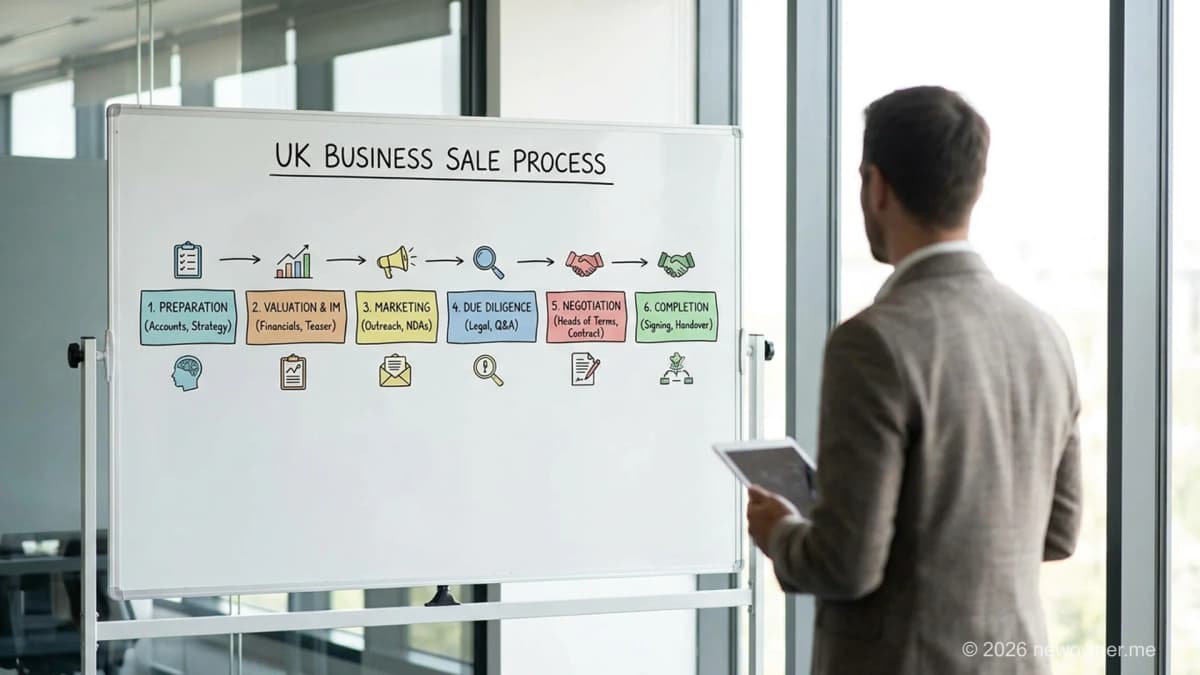
Here's how to sell a business in 2027, step by step, whether it's worth £250,000 or £5m. Each step carries a date range that assumes you start in the final quarter of 2026. Some take a week. Others take a winter.
Step 1: Get a realistic valuation (October to December 2026)
You can't price what you haven't measured. Most UK SMEs sell on a multiple of EBITDA, adjusted for one-off costs and owner perks, while very small owner-run firms often sell on seller's discretionary earnings instead. Run your figures through the business valuation calculator for a first range, then compare it with the 4.5x median above.
Expect the answer to sting a bit: owners anchor on the number they need, while buyers pay the number they can finance. For the method behind the maths, read how much your business is worth.
Step 2: Prepare the business for sale (October 2026 to March 2027)
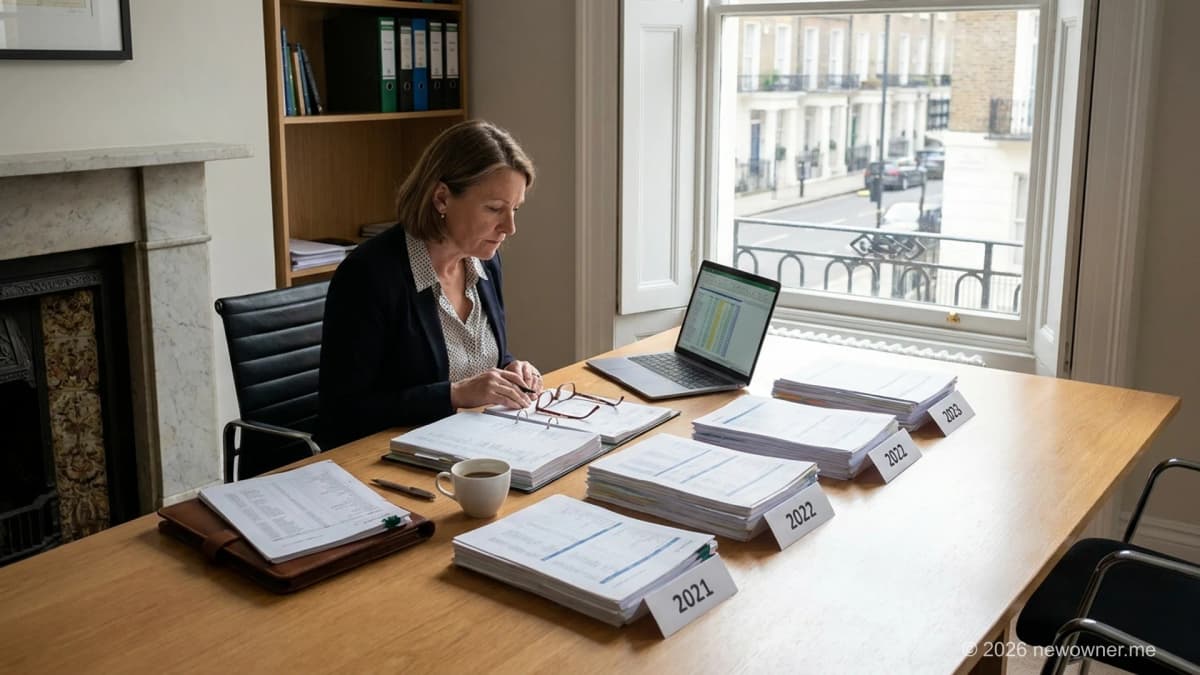
Buyers pay more for businesses that are easy to check. That means three years of accounts reviewed by an accountant, monthly management figures that tie back to them, and contracts, leases and IP held in the company's name rather than yours.
Two newer jobs belong on this list. Make sure every director and PSC has verified their identity with Companies House so your confirmation statement goes through. And check employment contracts, zero-hours arrangements and HR policies against the Employment Rights Act timetable (both are covered below).
Owner dependency is still the biggest value killer, though. If customers only ever deal with you, start handing them over now, not in month nine. Our guide on whether your business will sell shows how buyers test it.
Step 3: Plan the tax before you go to market (by January 2027)
Tax advice after heads of terms is too late. Check BADR eligibility now: for the two years before the sale you need at least 5% of the shares and voting rights (plus a 5% economic interest), you must be an officer or employee, and the company must be trading. Large cash balances or investment property inside the company can put trading status at risk, so ask about them early. A specialist M&A accountant will also look at pre-sale dividends, pension contributions and whether a share or asset sale suits you better. The tax section below has a worked example.
Step 4: Choose your route to market (January to February 2027)
You've got four realistic options: a business broker, a corporate finance adviser, a direct approach to a competitor or supplier, or listing it yourself on a marketplace. Brokers earn their fee when they bring buyers you couldn't reach and run a competitive process. On smaller deals that often isn't the case, and the commission comes straight out of your proceeds. We ran the numbers in NewOwner vs UK business brokers.
Selling in 2027? On NewOwner's Seller plan you list for £99 a month and message buyers yourself. No success fee, no completion commission. Start your listing.
Step 5: Build the information memorandum and data room (February to March 2027)
The information memorandum (IM) is your sales document. It covers what the business does, three years of revenue, gross margin and normalised EBITDA, how operations and the team work, where a new owner could grow it, and the price and structure you want. Ten to fifteen pages is plenty for a small business.
Your reason for selling goes in too, and buyers will test it. Our piece on why you're selling covers how to frame it without spin.
Build the data room at the same time: statutory books, filed accounts, tax returns, customer and supplier contracts, leases, anonymised staff data and your Companies House filings. Every document you load now is time you won't lose in due diligence. Nobody sees the IM without a signed NDA.
Step 6: Market the business and qualify buyers (March to June 2027)
Once you're live, enquiries come in waves, and plenty won't be serious. Qualify people before you share anything detailed:
- Signed NDA, no exceptions
- Proof of funds, or a named lender and an agreement in principle
- Have they bought a business before? If not, who's advising them?
- A reason for buying that makes sense for your sector
Private equity firms, search funders and serial acquirers will often ask for a management call early. That's normal. Someone asking for your customer list on the first call isn't.
Step 7: Agree heads of terms, then get through due diligence (June to September 2027)
Heads of terms set out the price, the structure, any earn-out or deferred consideration, exclusivity and a target completion date. Most of the document isn't legally binding, but exclusivity and confidentiality clauses usually are, so read it with your solicitor. Our guide to heads of terms walks through each clause from the buyer's side.
Due diligence usually runs 6 to 12 weeks. The buyer's accountants and lawyers test your financials, tax, contracts, staff and compliance. In 2027, expect some of that reading to be done by AI tools first, which means contradictions between your IM, your accounts and your Companies House record get found quickly. Reconcile them yourself before the data room opens.
Step 8: Sign the SPA and complete (September to December 2027)
The share purchase agreement (SPA) is the binding contract. It holds the warranties (statements about the business you stand behind), indemnities for specific known risks, any price-adjustment mechanism, and the disclosure letter that qualifies your warranties. Negotiate warranty caps and time limits hard. Most post-completion arguments start here.
Completion often happens on the same day as signing. After that there's usually a handover period, and if part of the price is an earn-out you'll stay involved until the targets are measured. Only accept earn-out targets you can still influence once you no longer control the business. Then there's the tax return, covered below.
How much does it cost to sell a business in the UK?
The cost of selling a business depends mostly on one decision: whether you pay a broker a success fee. Legal and accountancy fees are unavoidable. Commission isn't.
| Cost | Typical range | Basis |
|---|---|---|
| Business broker, no-sale-no-fee | 8-15% of the sale price | NewOwner broker fee comparison |
| Business broker, retainer model | £3,000-£10,000 upfront plus a lower success fee | NewOwner broker fee comparison |
| NewOwner Seller plan | £99 a month, no success fee, cancel anytime | NewOwner pricing |
| Solicitor, simple share sale | £8,000-£15,000; around 1% or more on complex deals above £2m | NewOwner planning range, get two fixed-fee quotes |
| Accountant, deal support and tax | £2,000-£7,000 | NewOwner planning range |
| W&I insurance, if the buyer wants it | Average rate of 0.91% of the insured limit (UK buy-side, 2023-24) | Lockton UK transactional risk update |
Take an £800,000 sale. A 10% broker fee is £80,000. Nine months on the NewOwner Seller plan is £891. Add roughly £12,000 of legal work and £5,000 of accounting to both routes, and the gap is still about £79,000 before tax.
Fair warning: on a marketplace you do the broker's job yourself. You answer enquiries and qualify buyers, and it's on you to keep the deal moving between the solicitors. If you won't have the time, budget for some help, because a stalled process costs more than a fee.
One small consolation. Professional fees you pay to make the sale are deducted when you work out the gain, so they reduce your CGT bill a little.
How long does it take to sell a business? A 2027 timeline
Most UK business sales take 6 to 12 months from going to market to completion, plus preparation beforehand. If you're working out how to sell a business against a deadline, map it onto the calendar first. This is the calendar if you start in October 2026 and complete in late 2027. Durations are NewOwner planning ranges for owner-managed businesses; the tax deadline comes from HMRC.
| Phase | Calendar | Typical length | What gets done |
|---|---|---|---|
| Preparation | Oct 2026 to Mar 2027 | 3-6 months | Accounts, owner dependency, ID verification, tax advice |
| Valuation and IM | Jan to Mar 2027 | 4-8 weeks | Valuation, IM, data room, NDA |
| Marketing | Mar to Jun 2027 | 2-4 months | Listing, enquiries, buyer calls |
| Heads of terms | Jun 2027 | 2-6 weeks | Price, structure, exclusivity |
| Due diligence | Jun to Sep 2027 | 6-12 weeks | Financial, legal, tax and HR checks |
| SPA and completion | Sep to Dec 2027 | 4-8 weeks | Warranties, disclosure, signing |
| CGT payment | By 31 Jan 2029 | - | Self Assessment for a 2027/28 disposal |
How to sell a business quickly without losing value
Speed comes from preparation, not from dropping the price. A data room that's full on launch day, accounts a lender can underwrite and a realistic asking price save more weeks than anything else you can do.
What slows a sale down? Messy accounts. Open HMRC enquiries. Disputed IP, lease problems, or a major customer contract that can't be assigned. And, more than anything in 2027, a buyer whose finance wobbles halfway through due diligence. If you need out fast, a cash buyer or an existing competitor can move faster than a first-time buyer with a bank loan, but you'll usually give up some price for that certainty.
Tax on selling a business: BADR at 18% with a worked example
Business Asset Disposal Relief (BADR) is the relief that taxes qualifying business gains at a flat rate, up to a £1m lifetime limit. From 6 April 2026, the BADR rate is 18%, and it has gone up in two steps:
| Disposal date | BADR rate | Tax on £1m of qualifying gain |
|---|---|---|
| On or before 5 April 2025 | 10% | £100,000 |
| 6 April 2025 to 5 April 2026 | 14% | £140,000 |
| From 6 April 2026 | 18% | £180,000 |
Outside BADR, gains are taxed at 18% or 24% depending on your income, after a £3,000 annual exempt amount for 2026/27. So the relief is now worth 6 percentage points to a higher-rate taxpayer on up to £1m of gains. That's £60,000. Still worth having, but no longer a reason to rush a sale.
Worked example: a £1.2m share sale in 2027/28
Say you own all the shares in a Leeds IT support company. You subscribed £100 for them years ago, you've been a director throughout, and you sell for £1.2m in July 2027. You're a higher-rate taxpayer. Assuming the 2026/27 rates and allowance carry into 2027/28:
- Gain: about £1.2m, before deducting the £100 and your sale costs
- First £1m at the BADR rate of 18%: £180,000
- Remaining £200,000, less the £3,000 annual exempt amount, at 24%: £47,280
- Total CGT: £227,280. Without BADR the bill would be £287,280.
Your legal and adviser fees reduce the gain, so the real figure will come in a little lower. For the full eligibility rules and timing questions, read our BADR guide.
Reporting and paying the CGT
The 60-day CGT deadline applies to UK residential property, not to shares or a business. You report a business gain through Self Assessment for the tax year of the sale, or through HMRC's real-time CGT service, which needs the report by 31 December after the tax year ends and payment by 31 January. A July 2027 sale falls in 2027/28, so the tax is due by 31 January 2029. You also have to claim BADR in time: the deadline is the first anniversary of the 31 January after the tax year, which for a 2025/26 disposal means 31 January 2028. For the July 2027 sale in the example, it's 31 January 2030.
Budget caveat: this guide was updated in October 2026, before the Budget on 28 October 2026. No change to BADR or CGT rates for 2027/28 had been announced when it was written. If the Budget changed either, redo the worked example above and check gov.uk before you agree a completion date.
New rules for 2027 sellers: Companies House ID checks and employment law
Two newer sets of rules now turn up in almost every due diligence questionnaire. Neither stops you selling. Both can delay completion, or knock money off the price, if you ignore them.
Companies House identity verification
Under the Economic Crime and Corporate Transparency Act 2023, identity verification became mandatory on 18 November 2025. New directors and PSCs verify when they're appointed. Existing directors confirm it with the company's next confirmation statement during a 12-month transition, and the government estimated that 6 to 7 million people would need to verify by mid-November 2026.
For a sale, this matters twice. Your own directors need to be verified, or the confirmation statement won't be accepted, and a buyer's lawyer will spot that straight away. The buyer's incoming directors also have to verify before they can be appointed at completion. Raise it at heads of terms, not on completion morning.
The Employment Rights Act 2025 timetable
The Employment Rights Act 2025 received Royal Assent on 18 December 2025 and is coming into force in stages. The government's implementation timetable lists these dates that matter in a sale:
| Change | Date | Why a buyer cares |
|---|---|---|
| Statutory sick pay from day one; maximum protective award for collective redundancy failures doubled | 6 April 2026 | Sickness costs more, and a botched restructuring costs more |
| Employment tribunal time limit extended from 3 to 6 months | 1 October 2026 | A longer tail of claims after completion, so wider indemnities |
| Duty to take all reasonable steps to prevent sexual harassment | 30 October 2026 | Buyers ask to see policies and training records |
| Unfair dismissal qualifying period cut to 6 months; compensatory award cap removed | 1 January 2027 | Post-deal restructuring gets riskier and dearer |
| Restrictions on fire and rehire | January 2027 | Harder to harmonise terms after an acquisition |
| Guaranteed hours for zero-hours workers | Later in 2027, after consultation | Cost questions for businesses that rely on flexible staff |
In an asset sale, TUPE moves your staff to the buyer on their existing terms, and the new rights travel with them. In a share sale the company stays the employer, so any compliance gap stays inside the business the buyer is acquiring. Either way, expect employment warranties to get longer in 2027. Tidying contracts and policies before you list is cheaper than conceding an indemnity later.
Who is buying UK businesses in 2027
Your buyer pool shapes the price and how the deal gets paid. Five groups matter for owner-managed businesses, and they behave quite differently.
Trade buyers and private equity
Competitors, suppliers and PE-backed groups still pay the strongest prices for businesses with recurring revenue and a management team. PwC's mid-year data shows capital concentrating on fewer, larger assets. Smaller sellers have to make their business easy to check to get onto those shortlists.
Search funds
A search fund is a vehicle in which an individual, backed by investors, looks for one company to buy and then runs it. IESE's 2024 study tracked 320 search funds outside the US and Canada up to the end of 2023, including 35 first-time UK funds. The median deal had $7.8m of revenue and an $11.7m price, so search funds matter most if your business sits at the larger end of the SME range. Expect detailed questions and a structured process.
Employee ownership trusts
The EOT route lost half its tax advantage in November 2025. Even so, the Employee Ownership Association expected around 500 more businesses to move into employee ownership during 2025. If your team would keep the business going and you're happy to be paid over several years, it's a serious option, especially where no outside buyer is obvious.
Individual buyers using debt
A lot of smaller businesses are bought by individuals funding the price with bank debt, seller finance and savings. They live or die by their lender's view of your accounts. Have three years of clean figures ready, and expect to be asked to defer part of the price.
Buyers using AI in due diligence
Buyers increasingly run your documents through software before a human reads them. In Accenture's 2026 survey of 650 senior dealmakers, 46% of organisations were investing in generative AI for pre-deal M&A work, up from 31% in 2024. NewOwner's own Buyer plan includes an AI Analyst for due diligence. The practical upshot: contradictions between your IM, management accounts, filed accounts and Companies House record get caught early, so make sure every document tells the same story.
Broker or marketplace: where to sell my business
When owners ask us how to sell a business without overpaying, the answer depends on deal size and how much time they've got. Here's how we'd decide:
- Straightforward business, up to roughly £2m: a marketplace plus a good solicitor and accountant is usually the cheapest sensible route. You keep control of enquiries and pay no commission.
- Niche sector with a specialist broker who already knows the buyers. The broker can earn the fee, but only if they can name buyers you couldn't reach yourself.
- Above £5m, or an international buyer pool? A corporate finance adviser running a competitive process often lifts the price by more than they charge.
NewOwner is a UK marketplace for buying and selling businesses. On the Seller plan (£99 a month, billed monthly, cancel anytime) you create listings, upload financial documents, receive enquiries and message buyers directly, with listing analytics showing views and contact requests. We don't take a percentage of the sale. Buyers pay £49 a month for full access to financials and messaging, so the people contacting you have paid to be there.
Want to see how other owners present their numbers? Browse UK businesses for sale before you write your own listing.
Common mistakes when selling your business
Part of knowing how to sell a business is knowing how sales fall apart. Most fail for predictable reasons, and these six come up again and again:
- Overpricing. An asking price far above what the earnings support doesn't produce a higher offer. It produces silence, then a low bid from someone who has spotted a stale listing.
- Messy accounts. If a buyer can't reconcile your management accounts to the filed ones, they cut the price or walk away.
- Owner dependency, where every customer relationship runs through you and the buyer ends up buying a job.
- Leaking the sale too early. Staff and customers hearing about it before you're ready leads to resignations and nervous renewals, so keep the circle small.
- Late tax advice. A structure you can't change after heads of terms can cost more than any price concession.
- Fighting over price and ignoring terms. An earn-out you can't influence, or uncapped warranties, can cost more than a lower headline from a cleaner buyer.
There's a longer list, with fixes, in our guide to common seller mistakes.
If you want the same process told from a different angle, read selling without losing your shirt.
How to sell a business in 2027: your next step
If you take one thing from this guide on how to sell a business in 2027, make it this: most of the work happens before you list. Get a valuation range this quarter and fix the accounts and the owner dependency over the winter. Tax advice should land before January. Do that and you can be in front of buyers by spring 2027, with completion inside the 2027/28 tax year.
You don't need a broker to get there. List your business for sale on NewOwner for £99 a month with no commission on the price, and deal with buyers directly while your solicitor and accountant handle the legal and tax work.