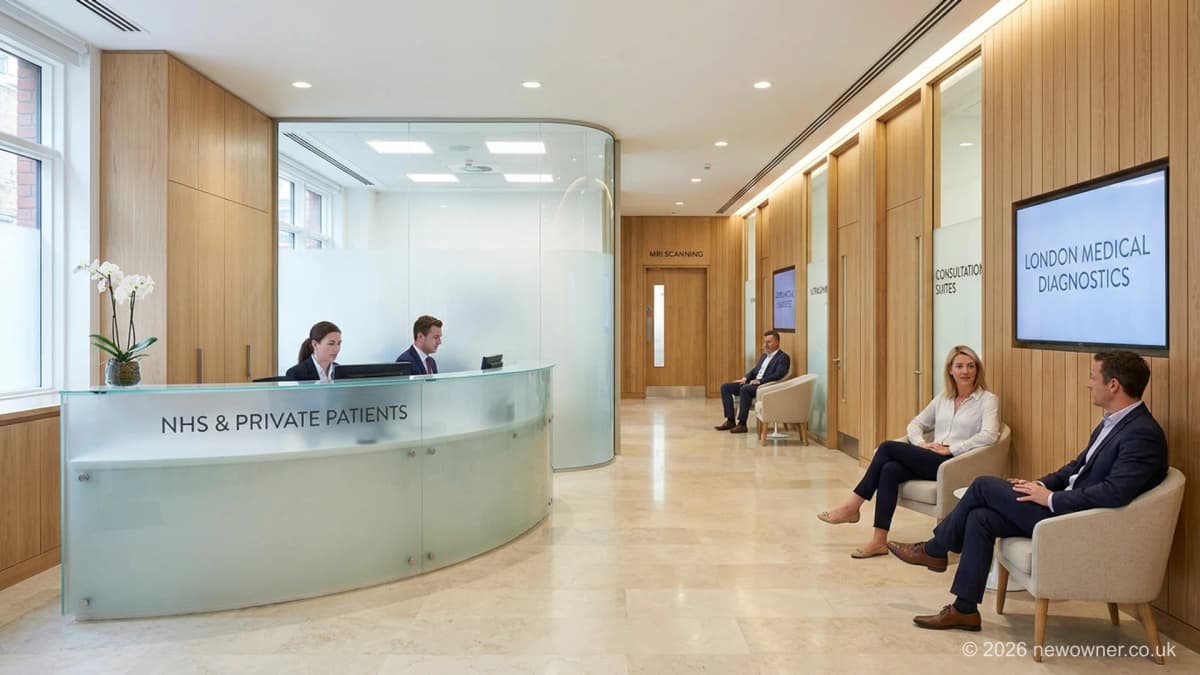
UK private medical clinics and homecare agencies are driven by structural demographic demand, requiring rigorous Care Quality Commission (CQC) compliance audits.
- The UK private medical and homecare market
- Care Quality Commission (CQC) registration: the central regulatory hurdle
- Clinician dependency: managing doctors, consultants, and practising privileges
- Healthcare premises: freehold buildings versus commercial leases
- Dedicated homecare section: domiciliary care economics and local authority fees
- Healthcare valuation benchmarks and EBITDA multiples
- Pre-offer due diligence checklist for healthcare acquirers
The UK private medical and homecare market
When searching for a private medical clinic for sale UK, buyers find a market experiencing rapid growth. NHS waiting lists, an ageing population, and corporate Private Medical Insurance (PMI) expansion mean patients are increasingly willing to pay out-of-pocket for general consultations, diagnostics, and in-home elderly care.
On NewOwner, healthcare listings encompass two primary operating models: established private medical centres—ranging from prime multi-consulting room freehold clinics in London to regional outpatient diagnostic facilities in locations such as Chichester—and regulated domiciliary homecare agencies serving regional territories like County Durham. This guide focuses specifically on general medical centres, outpatient clinics, diagnostic practices, private GP surgeries, and domiciliary homecare agencies (dental acquisitions are covered in our dedicated dental practice buyer's guide).
The private medical centre operational spectrum
To understand a private clinic's revenue, you need to categorise its core clinical activities:
- Private GP and Family Medicine: Same-day 30-minute consultations, routine blood tests, executive health screening, and travel vaccinations billed directly to self-paying patients.
- Specialist Outpatient Consulting Suites: Consultant physicians (cardiologists, dermatologists, orthopaedic specialists, gynaecologists) conducting initial assessments and post-operative reviews under private medical insurance (PMI) networks.
- Diagnostic and Imaging Facilities: On-site digital X-ray, multi-slice CT, MRI, and high-resolution ultrasound providing rapid scan appointments with specialist radiology reporting turnaround within 24 hours.
- Ambulatory Day-Case and Minor Surgery: Dedicated clean treatment rooms delivering minor skin excisions, joint injections, endoscopy, and ophthalmic procedures under local anaesthesia without overnight hospital admission.
Private Medical Insurance (PMI) network recognition
Clinic value depends heavily on its accredited recognition across major UK health insurers (Bupa, AXA Health, Aviva, Vitality, and WPA). Inquire whether the clinic holds institutional provider recognition numbers. If consultations are recognised directly for direct-settlement billing, patient conversion is substantially higher than if patients must self-fund and claim reimbursement manually.
Care Quality Commission (CQC) registration: the central regulatory hurdle
The biggest operational hurdle when buying a UK medical clinic or homecare agency is the Care Quality Commission (CQC) registration process. A failure to structure the transaction around CQC timetables can force an operational shutdown on completion day.
Why CQC registration belongs to the provider entity, not the premises
A common misconception among first-time healthcare buyers is that CQC registration attaches to the building. It doesn't. Registration is granted to a specific legal person or entity (a sole trader, partnership, or limited company) to carry on defined Regulated Activities (such as Treatment of disease, disorder or injury, Diagnostic and screening procedures, or Personal care).
The legal structure: Share Purchase versus Asset Purchase
How you structure the legal transaction fundamentally dictates your regulatory pathway:
- Share Purchase (Entity Acquisition): The buyer acquires 100% of the issued shares in the existing limited company. Because the registered corporate entity remains unchanged, the CQC provider registration remains intact. The transaction only requires formal notification of a change of directors/shareholders and, if the existing Registered Manager is departing, an application for a new Registered Manager. Operations continue without interruption on completion day.
- Asset Purchase (Trade and Assets): If you purchase the business assets into a new corporate vehicle, the seller's CQC registration can't be transferred. Your new purchasing company must submit a brand-new CQC Provider Application from scratch. In 2026, CQC provider registrations take between 12 and 18 weeks to process, including enhanced DBS disclosures, fit and proper person interviews, and registered manager assessments. Because it is illegal to provide regulated activities without active registration, an asset purchase creates an unavoidable trading void unless completion is made strictly conditional upon the buyer obtaining advance CQC approval.
CQC Transaction Pathway Comparison:
Pathway A: Share Purchase (Corporate Continuity) [Buyer Acquires 100% Shares] ---> [CQC Corporate Provider ID Retained] ---> [Uninterrupted Trading] | +--> [Submit Regulated Manager Change Notice]
Pathway B: Asset Purchase (Statutory Standstill Risk) [Buyer Forms New Entity] --------> [Submit New CQC Provider Application] --> [12–18 Week Wait] | | +--> [Enhanced DBS & Fit/Proper Reviews] +--> [No Care Permitted Until Active]
The CQC Single Assessment Framework
The CQC evaluates healthcare providers under its Single Assessment Framework, focusing on five key questions (Is the service Safe, Effective, Caring, Responsive, and Well-led?). Review the provider's evidence against CQC Quality Statements:
- Learning Culture and Safeguarding: Mandatory policies for investigating clinical incidents, learning from complaints, and statutory Duty of Candour reporting.
- The Registered Manager and Nominated Individual: Every regulated provider must appoint a designated Registered Manager (legally accountable for operational compliance) and a Nominated Individual (representing the corporate board). If the outgoing vendor currently serves as the Registered Manager, you must recruit or promote a qualified replacement well before completion.
Clinician dependency: managing doctors, consultants, and practising privileges
A private medical centre generates revenue through the clinical services delivered by General Practitioners, specialist consultant physicians, surgeons, radiographers, and physiotherapists. Understanding the legal and economic relationship between the clinic and its clinicians is essential to assessing sustainable earnings.
Practising privileges versus direct employment
In UK private medical centres, the majority of senior specialist consultants are not PAYE employees. Instead, they operate as independent contractors under a legal framework known as Practising Privileges:
- The Practising Privileges Agreement: A formal contract granting an accredited specialist the right to consult and treat private patients within the clinic facilities in exchange for paying the clinic a percentage of patient fees (typically 20% to 35%) or a sessional room rental fee (e.g. £80 to £150 per four-hour consulting session).
- The Medical Advisory Committee (MAC): A properly governed clinic maintains a MAC composed of senior clinicians that reviews credentials, validates GMC registration, and monitors clinical audit outcomes. Make sure the clinic's MAC minutes over the previous 24 months show rigorous clinical governance and regular reviewing of practising privileges.
Consulting room economics: fee split versus room rental
| Consulting Suite Economic Metric | Model 1: Practising Privileges (30/70 Revenue Share) | Model 2: Sessional Room Rental (£140 / Session) |
|---|---|---|
| Gross Patient Billings per Suite/Day | £4,160 (8 consults @ £220 + minor ops @ £2,400) | £4,160 (Billed directly by visiting doctor) |
| Doctor Professional Fee Disbursement | -£2,912 (70% disbursed to specialist) | £0 (Specialist retains 100% of patient fees) |
| Gross Clinic Revenue Retained | £1,248 (30% revenue share) | £280 (Two 4-hour room sessions @ £140) |
| Direct Consumables, Chaperone, Sterilisation | -£220 (Nurse chaperone, sterile consumables) | -£45 (Room cleaning and patient reception) |
| Net Daily Contribution to Clinic Overhead | £1,028 per suite / day | £235 per suite / day |
| Annualized Net Contribution (240 Days) | £246,720 per consulting suite | £56,400 per consulting suite |
| Operational & Governance Profile | Higher CQC audit burden; maximum clinic upside | Passive commercial rent; zero doctor billing exposure |
Clinical compliance audits during due diligence
Before committing to an acquisition, instruct your healthcare solicitor to audit every active clinician's compliance file for:
- General Medical Council (GMC) Status: Verification of full registration on the GMC Specialist Register with an active Licence to Practise, free of warning conditions or interim orders from the Medical Practitioners Tribunal Service (MPTS).
- Medical Indemnity Insurance: Evidence that every clinician holds current clinical negligence indemnity cover with a recognised medical defence organisation (such as the MDU, MPS, or MDDUS) with indemnity limits adequate for their clinical specialty.
- Appraisal and Revalidation: Annual whole-practice appraisal portfolios and current GMC revalidation status (statutory five-year cycle under the Responsible Officer regulations).
- Chaperone and Patient Consent Policies: Verification that clinical staff adhere to formal GMC guidance on patient consent, clinical note-taking, and chaperone availability for intimate examinations.
- Key-Clinician Concentration: If a single renowned dermatologist or private GP accounts for 45% of total clinic consultations, you face substantial revenue flight risk if they relocate to a competing clinic.
Healthcare premises: freehold buildings versus commercial leases
Physical medical clinics require specialised building infrastructure and statutory planning designations. When evaluating healthcare real estate—such as London freehold clinic listings that include the underlying property asset—carefully assess the following planning and technical criteria.
Town and Country Planning: Use Class E(e)
Under the Town and Country Planning (Use Classes) Order, private clinics and medical centres must hold lawful planning use under Class E(e) (commercial, business and service - for the provision of medical or health services, principally to visiting members of the public). If a clinic operates under historic Class D1 permissions or an unauthorized residential-to-clinic conversion without formal planning regularisation, neighbours or the local planning authority can serve an enforcement notice halting medical operations.
Clinical infection control and facilities compliance
Medical premises must satisfy Department of Health Health Technical Memoranda (HTM) standards, specifically:
- HTM 01-05 & HTM 03-01: Decontamination facilities, clean and dirty instrument flow corridors, and specialized clinical ventilation delivering at least 10 to 15 air changes per hour in minor surgery procedure rooms.
- Medical Gas Pipeline Systems (MGPS - HTM 02-01): Where clinical oxygen, nitrous oxide, or vacuum lines are piped into treatment bays, audit annual inspection certificates and statutory cylinder storage isolation vaults.
- Acoustic Confidentiality: Under CQC privacy standards, consulting room partitions must provide a sound reduction index of at least 45 to 48 dB (Rw) so that sensitive medical consultations cannot be overheard in waiting corridors.
- Clinical Waste Management: Statutory consignment notes and commercial collection contracts for hazardous medical waste, cytotoxic pharmaceuticals, and sharps disposal under the Environmental Protection Act 1990.
- Accessibility and Equality Act 2010: DDA-compliant disabled access, automated doors, accessible patient toilets, hearing induction loops, and compliant passenger lifts.
Freehold versus leasehold implications
Acquiring a medical clinic that includes the freehold building gives you long-term stability. Healthcare facilities require hundreds of thousands of pounds in tenant fit-out capex (lead-lined X-ray rooms, sterile air handling, consulting washbasins with non-concussive taps). In a leasehold clinic, you risk landlord forfeiture or contentious dilapidations claims upon lease expiry. Also, commercial mortgage lenders look favourably upon freehold medical properties, offering up to 65% to 70% LTV against RICS medical property valuations.
Dedicated homecare section: domiciliary care economics and local authority fees
Domiciliary care agencies (homecare businesses) provide visiting personal care, medication administration, and domestic assistance to elderly and vulnerable individuals living in their own homes. Unlike static clinics, a homecare agency's primary operational asset is its field care workforce and registered branch office.
The two economic engines: Local Authority vs Private Self-Pay
When evaluating homecare agencies—such as regional businesses operating in the North East or South Coast—the most critical due diligence metric is the revenue mix between local council frameworks and private fee-paying clients.
| Operational Dimension | Local Authority Framework Contracts | Private Self-Pay Clients |
|---|---|---|
| Hourly Charge Rate (2026) | £19.50 – £24.00 per hour (tightly capped) | £29.00 – £38.00+ per hour (market-driven) |
| Gross Profit Margin | 18% – 25% gross margin | 35% – 48% gross margin |
| Volume & Predictability | High volume; guaranteed shift blocks; predictable hours | Lower individual volume; requires continuous consumer marketing |
| Payment Terms | 30 to 60 days in arrears; administrative payment delays | Weekly or monthly Direct Debit in advance; minimal bad debt |
| Contract Vulnerability | High: periodic council tender renewals can reallocate packages | Low: individual contracts with families; high customer loyalty |
Agencies reliant entirely on Local Authority contracts operate on razor-thin margins. A rise in the National Living Wage or employer National Insurance immediately erodes council contract profitability unless the local authority grants an above-inflation fee increase. Conversely, agencies with at least 50% to 60% private self-pay income deliver superior cash flow, higher EBITDA multiples, and defensive stability.
Digital compliance: electronic call monitoring and eMAR
Modern CQC inspection methodology penalises agencies operating paper-based records. Audit the provider's digital care management software (CarePlanner, Birdie, Mobizio, or Log my Care):
- Electronic Call Monitoring (ECM): GPS verification confirming that carers arrive and depart client homes within scheduled windows. High rates of shortened visits (e.g. 20-minute calls logged for 30-minute scheduled care) represent a severe regulatory red flag.
- Electronic Medication Administration Records (eMAR): Real-time medication logging with automated alerts for missed doses. Unrecorded medications trigger immediate CQC safeguarding warnings.
- Dynamic Purchasing Systems (DPS): Review the agency's tier status on regional council electronic procurement portals. Check that framework agreements aren't due for cyclical tender re-opening within 6 months of completion.
The true homecare bottleneck: carer recruitment and retention
In homecare, client demand is incredibly high; the limiting growth factor is carer recruitment and capacity. During operational due diligence, examine:
- Carer Churn Rate: The UK care sector averages annual staff turnover of roughly 30% to 35%. An agency with churn below 20% demonstrates superior culture and local management.
- Travel Time and Mileage Compliance: Under UK National Minimum Wage legislation (HMRC guidelines following the Menezes case), carers travelling between client calls must be paid for travel time. If an agency only pays for 'time on client premises', it risks massive retrospective HMRC back-pay assessments and fines.
- Unfulfilled Care Hours: Review the electronic call monitoring (ECM) system. If the agency regularly hands back care packages or logs missed calls, CQC inspection downgrades are imminent.
Healthcare valuation benchmarks and EBITDA multiples
UK healthcare businesses are valued primarily on Normalised EBITDA, with transaction multiples reflecting regulatory compliance, customer concentration, and clinical autonomy.
| Healthcare Sub-Sector | EBITDA Multiple Range | Typical Gross Margins | Key Valuation Value Drivers |
|---|---|---|---|
| General Outpatient Medical Centre | 4.5x – 6.5x EBITDA | 40% – 55% | Diversified specialist base, high PMI acceptance, Class E(e) freehold property. |
| Diagnostic & Imaging Hub | 5.5x – 7.5x EBITDA | 50% – 65% | Modern MRI/CT capital assets, private GP referral networks, NHS subcontracting. |
| Domiciliary Homecare (High Private Pay >60%) | 4.5x – 6.0x EBITDA | 35% – 45% | Low carer churn, high CQC rating ('Good' or 'Outstanding'), digital ECM. |
| Domiciliary Homecare (Local Authority Dominated) | 3.0x – 4.2x EBITDA | 18% – 25% | Multi-year framework contracts, high local density, automated payroll. |
| Allied Health / Multi-Disciplinary Clinic | 3.5x – 4.8x EBITDA | 45% – 60% | Physiotherapy, podiatry, and osteopathy integration; self-referral volume. |
EBITDA normalisations must be rigorous. If the founding doctor conducts private consultations without drawing a commercial fee, you must deduct the cost of replacement doctor sessions (typically £800 to £1,200 per day for an experienced private GP) to establish true operational profit.
Pre-offer due diligence checklist for healthcare acquirers
As healthcare M&A specialists, we always recommend conducting rigorous checks before exchanging contracts. Before exchanging contracts or committing non-refundable advisory fees, execute this focused healthcare verification roadmap:
- CQC Inspection History and Factual Accuracy Reports: Review the last two CQC comprehensive inspection reports across the five key questions (Safe, Effective, Caring, Responsive, Well-led). Request the unpublished draft inspection reports and review any statutory warning notices or conditions on registration.
- Radiation and Imaging Statutory Oversight: For diagnostic clinics with digital X-ray, OPG, or CT equipment, verify compliance with the Ionising Radiation Regulations 2017 (IRR17) and Ionising Radiation (Medical Exposure) Regulations 2017 (IRMER17). Audit the appointment of the Radiation Protection Adviser (RPA) and Medical Physics Expert (MPE).
- Clinical Negligence and Historical Malpractice: Demand written warranties confirming zero unresolved clinical negligence claims, GMC fitness to practise investigations, or medical Ombudsman complaints. Require confirmation of run-off indemnity cover from departing clinical directors.
- Safeguarding and Incident Logs: Audit the statutory Safeguarding Adults and Children incident logs in homecare operations under the Care Act 2014. Verify that all reportable incidents under Regulation 18 of the Care Quality Commission (Registration) Regulations 2009 were formally notified to the CQC within required statutory deadlines.
- Staff TUPE and Right-to-Work Verifications: Audit nursing and care staff files for enhanced Disclosure and Barring Service (DBS) certificates and compliance with UK Visas and Immigration (UKVI) sponsorship licence rules where international care workers are sponsored.
Browse active private medical clinic for sale UK listings on NewOwner — including healthcare opportunities across London, Manchester, Birmingham, and Scotland — to review available UK listings. Benchmark normalised EBITDA multiples with our UK Business Valuation Calculator, download our Business Buyer Starter Kit, and consult our business due diligence checklist, guide to liabilities in corporate acquisitions, and about NewOwner page before submitting formal Heads of Terms.