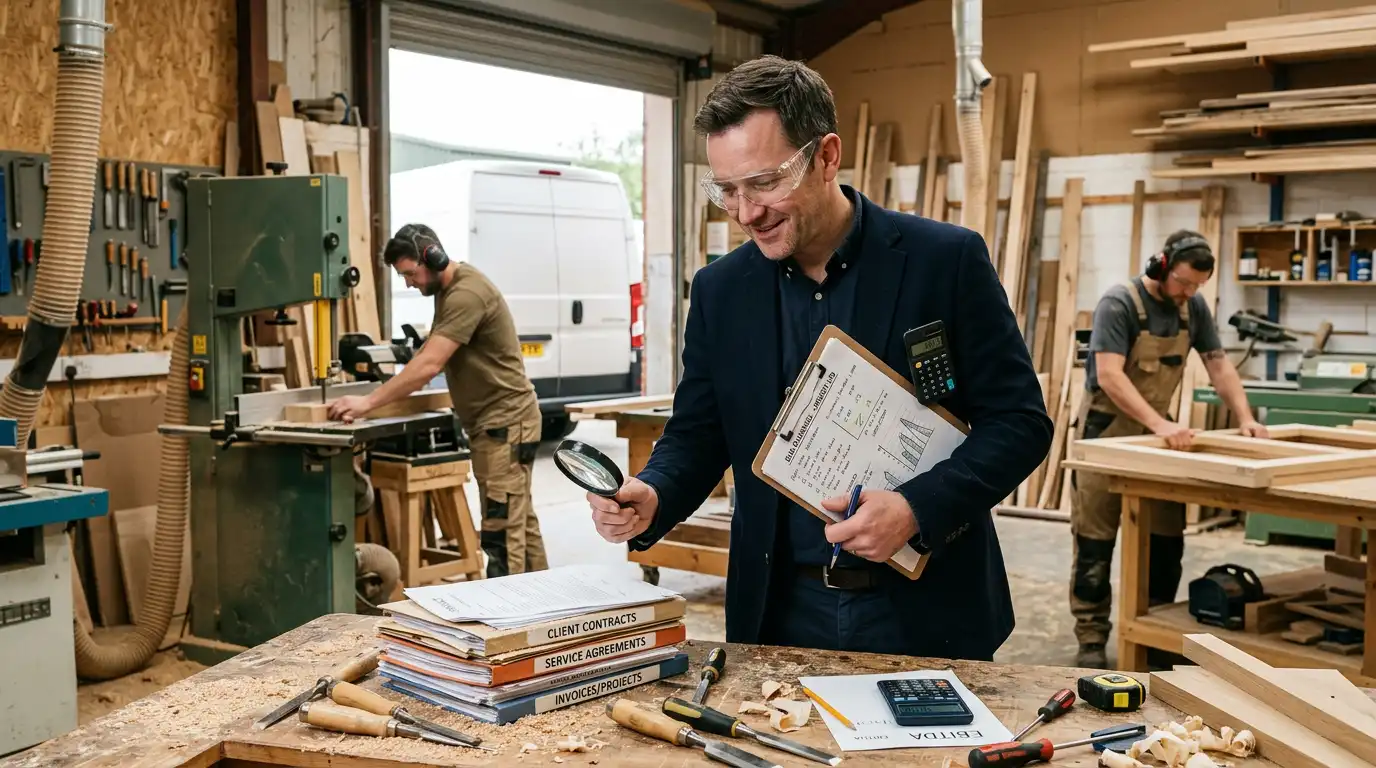
A joinery business for sale UK acquirers walk past is usually one of two things. Either a 25-year founder-led shop with longstanding trade customers and no succession plan. Or a younger shop with one big contract that looks like turnover but is actually concentration risk. The first kind is gold. The second kind sinks deals.
I've spent the last 18 months looking specifically at UK joinery, carpentry, HVAC, plumbing and electrical businesses because the sector has everything I want as a private buyer: real assets, recurring B2B customers, founder retirement turnover, and prices that haven't run away. This is what I've learned about valuing them, what kills the deals, and where the genuine bargains hide.
For live deal flow, browse joinery and trade businesses for sale on NewOwner. For the framework I use before making an offer, read on.
Why UK trade businesses are interesting in 2026
Four things make UK joinery and trade businesses worth a serious look right now.
First, the founder retirement wave is real. A large share of UK joinery, carpentry, HVAC, plumbing and electrical businesses were started by men now in their late 50s and 60s. They want to retire. There is rarely a successor in the family. The business is profitable but illiquid, and the founder doesn't know how to sell it. That mismatch creates patient-buyer opportunities.
Second, the multiples are sensible. Trade businesses typically transact at 3-5x normalised EBITDA, sometimes lower for sub-£500K profit operations. Compare that to SaaS at 6-10x ARR or care homes at 7-9x, and the entry economics are better.
Third, the businesses hold real assets. Vans, tools, plant, sometimes the freehold workshop. Asset-backed lending is straightforward, which lowers the equity requirement.
Fourth, the UK government's industrial strategy and reshoring incentives have been quietly supportive of skilled trades. Net-zero retrofit, heat pump installation, EV charger installation and commercial refurbishment all need installers. Demand isn't going anywhere for the next decade.
The honest counter-balance: skilled labour shortages are real and getting worse. Whoever owns the business has to be able to recruit and retain time-served tradespeople, or the contracts dry up regardless of how strong the book of business looks on paper.
The main categories of UK trade business for sale
Different trade categories have different multiples, customer mixes and risks. Here's what comes up most often in UK listings.
Joinery and carpentry
Bespoke joinery shops, kitchen fitters, staircase makers, shopfitting joiners, second-fix carpentry contractors. Customer mix usually split between trade (main contractors, developers) and direct retail. The best ones have a workshop plus 4-12 staff. Typical asking £180K-£850K depending on profit. Older shops with freehold workshops are worth more for the property.
HVAC and heating
Domestic heating, commercial HVAC installation and service. Subscription-style maintenance contracts are the gold standard because they create recurring revenue. Gas Safe and F-Gas certification is mandatory and tied to qualified individuals, not the business entity. Always confirm who holds the qualifications and whether they're staying post-acquisition.
Plumbing and drainage
Reactive plumbing, drainage contractors, commercial plumbing. Reactive work has feast-or-famine cash flow. Contract-based commercial work (housing associations, facilities management) is more predictable but margin is thinner. Typical multiples sit at the lower end of the trade range.
Electrical and renewables
Domestic and commercial electricians, EV charger installers, solar panel installers, smart-home specialists. The growth segments (EV, solar, heat pumps) trade at higher multiples (4-6x) than traditional electrical contracting. NICEIC certification matters and like Gas Safe it transfers with qualified staff, not the company.
Roofing and groundworks
Residential roofing, commercial flat roofing, civils and groundworks. Capital-equipment heavy. Plant and tipper trucks are major asset categories. Insurance costs run high (fall-from-height liability).
How UK trade businesses are valued
Three components drive a trade business valuation:
1. Normalised EBITDA
Strip out the owner's salary and replace with a market salary for an equivalent operator. Add back personal expenses run through the business. Add back any non-recurring items. The result is your normalised EBITDA. Apply a multiple of 3-5x for most trade businesses, higher for genuine growth or strong recurring revenue.
For the full method, see the normalised EBITDA guide or plug the adjusted earnings into our free UK Business Valuation Calculator.
2. Asset base
Vans, tools, plant, stock, work-in-progress. Get a separate valuation of tangible assets at fair market value (not book value, which is usually understated). Plant and vehicles aged 5+ years still have value if maintained.
3. Property if freehold
A freehold workshop is a separate valuation. Industrial freehold yields in the UK secondary market are running 6-9% in 2026. Apply to market rent to get a property value.
Worked example
A West Midlands joinery shop. Two-bay leasehold workshop. £820K turnover. Owner salary £52K, plus £12K personal expenses through the business, plus £8K family vehicle. Reported net profit £74K.
- Normalised EBITDA = £74K + £8K (family vehicle) + £12K (personal) + £52K (owner salary) less £42K (market manager salary) = £104K
- Multiple 3.5x = £364K (goodwill)
- Plant and tools fair value = £85K
- Stock at valuation = £30K
- Total deal value = ~£480K
This is roughly how I'd structure an indicative offer. The asking on a deal like this is often £550K-£650K. The negotiation usually settles around £450K-£500K.
What kills trade business deals
I've seen the same four issues kill deals repeatedly.
Customer concentration. If one client is 30%+ of turnover, the deal becomes a bet on that single client. Most lenders will discount the valuation, and most buyers should. A 50% concentration is usually a hard no.
Key-person dependency. If the founder is the only person with a particular trade qualification (Gas Safe registered engineer, NICEIC qualifying supervisor, F-Gas certificate holder), the business legally can't operate without them after they leave. Either negotiate a 12-24 month consultancy retention or walk away.
Work-in-progress accounting. Trade businesses often have months of WIP on the books at any time. How it's valued and whether it's recoverable matters more than the headline profit number. Get an independent quantity surveyor or accountant to review the open jobs.
Unpaid invoices. Construction and trade businesses have notorious payment delays. Look at the debtor book aged-debt analysis. Anything past 90 days is suspect, past 180 days is usually written off but still showing on the balance sheet.
More broadly, the how to analyse a business before buying guide and our UK Business Buyer Starter Kit cover the operational due diligence framework I use across all SME deals.
Financing a UK trade business acquisition
Trade businesses are easier to finance than service businesses because of the asset base. Typical structure for a £400K-£600K deal:
- Asset finance against vans and plant. 60-70% LTV against fair-market value of vehicles and equipment. Specialist lenders like Aldermore, Close Brothers and Hitachi Capital are active here.
- Cash flow loan for the goodwill portion. Available from the same SME lenders that fund acquisitions: ThinCats, OakNorth, Allica. Typically 50-65% LTV against 12-month forward EBITDA, repaid over 5-7 years.
- Buyer equity. 25-40% deposit.
- Seller financing or earn-out. Often 10-20% of goodwill, paid over 2-3 years and tied to retention of key customer relationships.
For buyers without significant equity, the how to buy a business with no money in the UK guide covers seller-finance, earn-out and LBO structures specifically applicable to asset-backed SMEs.
How to find a good UK trade business for sale
Sources in order of deal flow quality for an individual buyer with £100K-£400K equity:
- Direct marketplaces. Trade business listings on NewOwner across industrial hubs in Birmingham and the Midlands, Manchester, and Leeds. Direct contact with sellers, no broker commission inflating the asking price.
- Specialist trade-sector brokers. Eddisons, Hilton Smythe and KBS Corporate carry a significant volume of trade deals across the UK.
- Sector trade associations. The Joinery and Cabinet Makers Association, NICEIC, Gas Safe Register and other trade bodies occasionally circulate succession opportunities to members.
- Local accountants. Practices specialising in construction and trades hear about retirement-driven sales before anything reaches the open market.
- Direct cold approach. If there's a specific shop you've identified, write to the founder. About 1 in 10 will reply. Surprisingly effective in this sector because most founders don't have a clear path to exit.
Learn more about how NewOwner connects buyers and sellers directly, or check our best small businesses to buy UK 2026 guide, which places trade businesses in the top five for asset-backed deals.