- The car wash market nobody has properly counted
- How a car wash makes money, and how much
- What a car wash business for sale actually costs
- Reading a car wash site before you read the accounts
- Water, effluent and the permit you probably need
- Labour compliance: the part that can end a deal
- A worked example: the numbers on a hand car wash
- Where the growth actually is
- Should you buy a car wash business in the UK?
The car wash market nobody has properly counted
There are 35.8 million cars on UK roads and, according to the Car Wash Association, washing them generates over £1bn a year in sales. IBISWorld puts the wider car wash and vehicle detailing industry at £2.2bn across roughly 22,800 businesses in 2026.
Nobody knows how many hand car washes there actually are. Evidence given to Parliament's Environmental Audit Committee put the figure somewhere between 10,000 and 20,000 sites, and one witness told the committee that "90% plus would be unregulated". Official ONS classifications aren't granular enough to isolate car washes cleanly, so the honest answer is that this is a large, fragmented, under-measured market.
That's the opportunity and the risk in one sentence. A compliant, properly run car wash competes against a lot of operators who aren't paying what they should, which suppresses prices. It also means a genuinely clean business is scarce, and scarce things sell well.
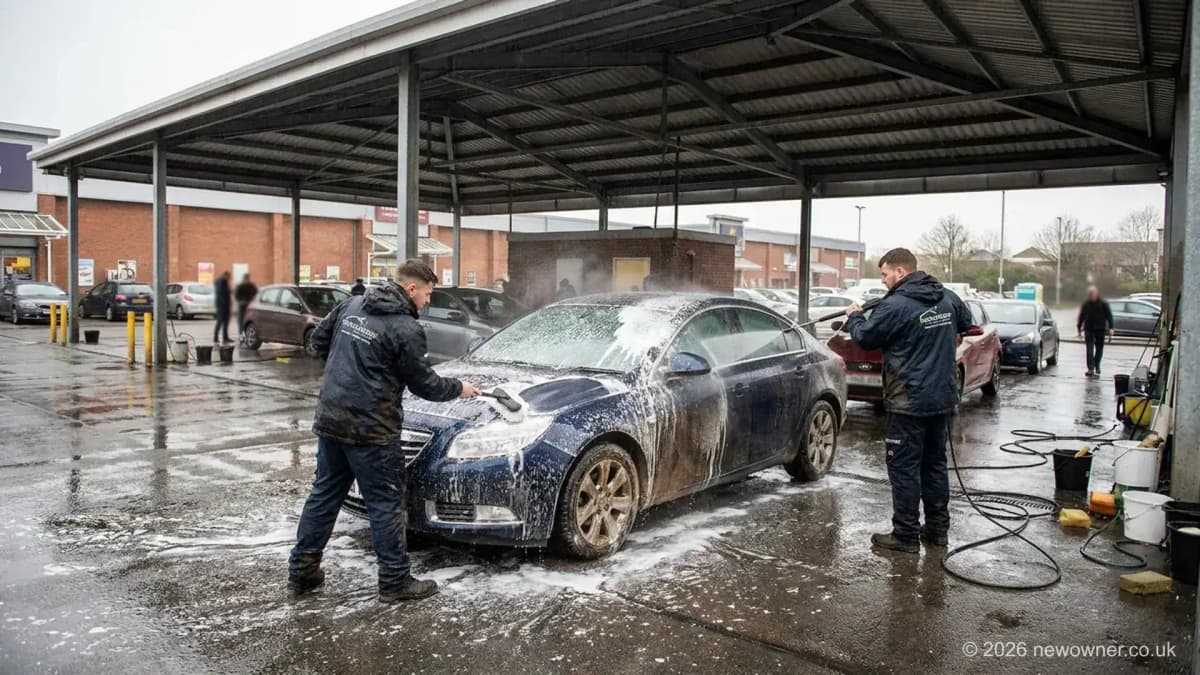
Hand washing won the last twenty years. Automatic site numbers fell by over 1,100 in the decade to 2016 while hand washes expanded into every spare corner of a supermarket car park. On the most-cited industry breakdown, from 2018, hand washes did around 110 million washes a year against 45 million by machine, and took over 80% of total sector income once valeting was included. Nobody has published a more recent split, so treat the shape as directional rather than current.
If you're looking at a car wash business for sale in the UK, this guide covers what they actually earn, what they sell for, and the two compliance areas that decide whether you're buying a business or a liability.
How a car wash makes money, and how much
Three formats, three completely different businesses.
Hand car wash. Labour-heavy, low capital. A team of four to eight, a jet wash, a canopy if you're lucky. Turnover scales with throughput and staff cost scales with it too, so margins are thinner than the cash-through-the-till appearance suggests.
Automatic or rollover. Capital-heavy, labour-light. A brush machine costs £60,000 to £150,000 installed, plus the site works. Once it's in, one attendant can run it. Volume per site is lower per car in revenue but the margin per wash holds up better because you're not paying five people.
Jet wash and self-service bays. The closest thing to passive income in this sector, and structurally similar to a vending machine round: coin or card in, service out, occasional maintenance. Lower revenue, much lower hassle.
Pricing tells you where the value sits. An automatic wash sells for £6 to £8. A hand wash sells for £10 to £20 exterior, £15 to £35 in and out, and a full valet runs £50 to £100. Customers pay double for hands because they believe the result is better. Whether that's true matters less than the fact they keep paying.
What a site turns over
Work it from throughput rather than trusting the seller's headline:
| Format | Cars per week | Average ticket | Weekly turnover |
|---|---|---|---|
| Small hand wash, roadside | 150 – 250 | £12 | £1,800 – £3,000 |
| Busy hand wash, retail car park | 350 – 600 | £14 | £4,900 – £8,400 |
| Automatic, forecourt | 400 – 900 | £7 | £2,800 – £6,300 |
| Hand wash plus valeting | 250 – 450 | £22 | £5,500 – £9,900 |
Sellers quote the good weeks. Ask for twelve months, because a car wash is weather-dependent and seasonal in a way that a shop isn't. Rain kills a Saturday. A dry, salty February is the best month you'll have.
What a car wash business for sale actually costs
Pricing in this sector is unusually messy, and it's worth understanding why before you make an offer.
Most hand car washes are leasehold, often on a licence or short lease over a corner of someone else's car park. Asking prices commonly run £25,000 to £120,000 depending on lease security, equipment and demonstrable takings. Sites with an automatic machine installed carry the equipment value on top, so £150,000 to £350,000 is normal. Freehold sites with land are a different market entirely, priced as property first and business second, which is worth reading up on in our guide to freehold businesses for sale.
On multiples, be careful. Car washes typically trade at 1x to 2x seller's discretionary earnings, which is low compared with most small businesses. There's a good reason: much of the earnings can't be verified, the lease is often weak, and the compliance risk is real. A buyer paying 2.5x for a car wash is either seeing something exceptional or hasn't done the work.
Here's the honest bit most guides skip. A large share of this sector operates partly in cash with informal labour. When a seller shows you £6,000 a week of turnover and £900 of declared wages for a six-person team, the numbers aren't telling you the business is profitable. They're telling you the business is non-compliant, and that liability can follow the trade.
You cannot buy undeclared income. You can't finance against it, you can't insure it, and you'll never sell it on. Value the business on what's declared, verifiable and legal. If that number doesn't work, walk away. Our business valuation guide sets out how to normalise earnings properly rather than accepting a seller's adjustments.
A note on these numbers. The UK has no published dataset of small business asking prices or transaction multiples: neither ONS nor any regulator collects them. The ranges above are drawn from current listings on the main UK marketplaces and from how brokers price this sector, so treat them as a sense-check on whether an asking price is sane, not as a valuation. The only numbers that matter for your deal are the ones in the seller's accounts.
Reading a car wash site before you read the accounts
Car washing is a location business pretending to be a service business. Traffic decides almost everything, so I'd assess the pitch before I'd open a spreadsheet.
Passing traffic and the ability to stop. A site on a 40mph road with no deceleration lane will underperform a slower road with easy access, even if the traffic count is higher. Watch how cars actually enter. If a driver has to make an awkward right turn across traffic, you lose most impulse trade.
Visibility and dwell. The best hand car wash sites sit where drivers are already stopping: supermarket car parks, retail parks, petrol forecourts, garden centres, gym car parks. People hand over the keys and go and do something else for twenty minutes. That combination of captive time and visible signage is worth more than raw traffic volume.
Stacking space. How many cars can queue on-site without blocking the road or the host retailer's traffic? A site that can hold four cars will turn away business on a busy Saturday. This is the constraint that caps turnover more often than demand does.
The host relationship. Many hand car washes operate on a licence over a corner of someone else's land. Find out who the landlord is, what the agreement actually says, how long it runs, and what notice either side can give. A supermarket that decides to reclaim the parking spaces can end your business with three months' notice, and no amount of goodwill protects you.
Water and power on site. Metered water supply, adequate pressure, and enough electrical capacity for a jet wash setup or a machine. Retrofitting a supply across a car park is expensive and needs the landowner's consent.
Shelter. A canopy changes the economics. It keeps the team working in rain, extends the season, and protects the equipment. Sites without one lose whole days.
The competition, honestly assessed. Drive a two-mile radius and count. Note their prices, their queue length at 11am on a Saturday, and whether they look compliant. If three sites within a mile are all charging £8 for something you'd need to charge £14 for to pay legal wages, you have a structural pricing problem that no amount of good service will solve.
The test I'd apply: would this site still work if the operator next door started doing everything properly and raised their prices? If your answer depends on being cheaper than someone who isn't paying minimum wage, that's not a business, it's a race you can't win.
Water, effluent and the permit you probably need
This is where car wash deals go wrong, and it's the first thing I'd check.
Wash water isn't rainwater. It carries detergent, oil, brake dust, silt and traffic film. Discharging it into a surface water drain, which runs to a river or stream, is a pollution offence. It has to go to foul sewer, which needs consent from the water company, and usually through an interceptor that separates oil and silt first.
The Environment Agency told Parliament it had opened 305 investigations in a year, with hand car wash cases making up 11% of them. That's not a theoretical risk. Enforcement happens, and it lands on whoever is operating the site, not whoever built the drainage.
What to establish before you exchange:
- Where does the wash water physically go? Trace it. Get the site drainage plan and, if there isn't one, pay for a survey.
- Is there a trade effluent consent from the local water company, in writing, and does it transfer to you?
- Is there an interceptor? When was it last emptied and who has the maintenance records?
- Does the site recycle water? Recycling systems cut water bills significantly and are increasingly expected on new consents.
- Any history of enforcement notices, complaints or visits?
A missing consent isn't automatically a deal-breaker. It's a price adjustment and a project. Retrofitting drainage and an interceptor on an existing hard-standing site typically runs £8,000 to £30,000. What matters is that you find out before completion rather than when an officer turns up in month three. Our due diligence checklist covers the general process, but this specific check needs a specialist.
Worth noting: planning is the sibling problem. Plenty of hand car washes operate on land without express planning permission for that use. Ask whether the use is lawful, and if the answer is vague, treat it as a no.
Labour compliance: the part that can end a deal
Hand car washing has a documented labour problem. Parliamentary evidence has repeatedly linked the sector to underpayment, cash wages, unsafe conditions and, at the sharp end, modern slavery.
Enforcement has been reorganised recently. The Gangmasters and Labour Abuse Authority's functions now sit with the Fair Work Agency, which brings minimum wage enforcement, employment agency standards and labour exploitation work under one roof with stronger powers. If you buy a site with an inherited workforce and inherited practices, you're the one who answers for it.
Practical checks before you buy:
- Payroll records for every worker, matched against hours worked. Count the staff on site yourself and compare with the payroll headcount. A six-person team on a two-person payroll is the single clearest red flag in this sector.
- Right to work documentation for all staff. Civil penalties for illegal working are substantial and are applied per worker.
- Accommodation arrangements. If the seller houses staff, understand exactly how, because that's a well-known indicator of labour exploitation.
- Who employs the team? Some sites use a labour provider. If so, check whether that provider is licensed and what the contract says about liability.
- Membership of the Responsible Car Wash Scheme, which exists precisely to give buyers and landlords a compliance benchmark.
The cleanest structure for a buyer is an asset purchase where you take the site and equipment, then recruit and employ your own team on PAYE from day one. It costs more to run. It's also the only version of this business you can grow, finance and eventually sell. If you're weighing up what liabilities transfer in different deal structures, our guide on buying a business with debt and liabilities is worth reading first.
Fair warning: if a seller gets evasive about payroll, that's your answer. Move on. There are plenty of sites.
A worked example: the numbers on a hand car wash
This worked example is an illustrative composite built from typical market figures, not a record of a specific transaction. Use it as a method for taking a deal apart, and run your own numbers on any business you actually look at.
Ranges only take you so far. Here's the shape of a typical deal: a hand car wash on a retail park corner, six staff, asking £85,000 for the goodwill and equipment with three years left on a licence from the landowner.
The seller's pitch. "£6,200 a week, all year. Nets me about £110,000." Equipment included, team stays, "no problems with the council".
What checking actually found:
Counting cars across two Saturdays, one Wednesday and one wet Tuesday gave an average of 405 cars a week at a blended £14.20 ticket. That's £5,750 a week, or £299,000 a year. Close enough to the seller's claim to be credible, and the card terminal reports backed roughly 60% of it.
Then the cost side, rebuilt at legal rates:
| Line | Annual | Notes |
|---|---|---|
| Turnover | £299,000 | Verified by count and terminal data |
| Wages, 6 staff, legal PAYE | £186,000 | Modelled properly, not from the seller's books |
| Licence fee to landowner | £31,200 | £600 a week |
| Water, power, chemicals | £22,400 | Metered supply |
| Insurance, waste, sundries | £9,800 | Includes interceptor emptying |
| Owner's earnings (SDE) | £49,600 | Against the seller's claimed £110,000 |
The gap between £110,000 and £49,600 is the whole story, and it isn't fraud. The seller's payroll ran at £127,000 for six people working roughly 60 hours a week each. Modelled at legal rates with holiday pay, employer NI and pension, that team costs £186,000. The seller wasn't lying about their profit. They were describing a profit that a compliant operator cannot reproduce.
Two further findings. The wash water ran to a surface water drain with no interceptor and no trade effluent consent, so a compliant retrofit was quoted at £18,000. And the licence had three years left with a six-month break clause in the landowner's favour.
Where that lands. Real SDE of about £49,600, minus £18,000 of immediate capital work, on an income stream that can be terminated at six months' notice. At 1.5x adjusted earnings, that's roughly £45,000 to £55,000, not £85,000. And that's before deciding whether you want a business whose previous margin came from underpaying people.
This is the single most common shape of car wash deal in the UK. The revenue is usually real. The profit usually isn't, once you cost the labour honestly. Model it that way from the start and you'll either get a fair price or a quick no.
Where the growth actually is
Compliant operators have an advantage that isn't obvious until you look at who's buying.
Fleet and trade contracts. Dealerships, leasing companies, taxi and private hire fleets, van fleets, car supermarkets. They need volume valeting, they pay on invoice, and increasingly their procurement teams require proof that you pay minimum wage and dispose of effluent legally. A non-compliant competitor literally cannot bid. That's a moat.
Subscription washing. Unlimited monthly plans have transformed the economics of automatic sites. You get predictable recurring revenue, higher lifetime value, and a business that's worth more at exit because the income is contracted rather than incidental. Machine sites suit this far better than hand washes.
Ceramic coating and paint correction. Detailing sits at a completely different price point: £300 to £900 a job against £15 for a wash. It needs skill and an indoor bay, but it turns a car wash into a business with actual margin.
Add-on retail. Air fresheners, screenwash, mats. Small, but it lifts the average ticket and costs nothing to try.
The one I'd prioritise is fleet work. It fills weekday daytime, it's invoiced, and it converts a weather-dependent cash business into something a lender will look at. That last point matters more than most buyers realise when it comes time to refinance or sell.
If you're funding the purchase plus a machine or drainage upgrade, read our guide to financing a business purchase in the UK before approaching a lender, because equipment finance and the acquisition loan are usually separate conversations.
Should you buy a car wash business in the UK?
Yes, if you buy the right one, and the right one is rarer than the listing count suggests.
The case for it is strong. Demand is structural: 35.8 million cars, all of which get dirty. Barriers to entry look low but real barriers exist for anyone wanting to operate legally, because drainage consent and a lawful planning use aren't easy to get on a new site. Entry prices are modest. Cash conversion is immediate, with no debtors and no stock.
The case against is equally clear. Weather-dependent revenue, thin margins on hand washing, a labour model that regulators are actively tightening, and an environmental liability that can arrive as an enforcement notice rather than a bill.
My take: the automatic and jet wash formats are the better buy for most people. Lower labour risk, better margins, subscription potential, and a machine that either works or doesn't rather than a workforce you have to manage into compliance. Hand washes can make good money, but they're a people business dressed up as a property business, and buyers routinely underestimate that.
Before you commit, do these five things:
- Sit at the site for two Saturdays and one weekday and count cars yourself.
- Trace the drainage and confirm the trade effluent consent in writing.
- Match the payroll headcount to the people actually working.
- Check the lease term and whether the landlord consents to the use.
- Value it on declared, verifiable earnings only, and run the normalised figure through our UK business valuation calculator.
You can browse businesses for sale on NewOwner, including regional listings in London, Birmingham, and Manchester, to compare car washes with other cash-generating businesses in the same bracket. The business buyer starter kit walks through how to compare deals consistently, and you can read about our verification standards or get in touch if you want a second opinion on a specific site before you offer.