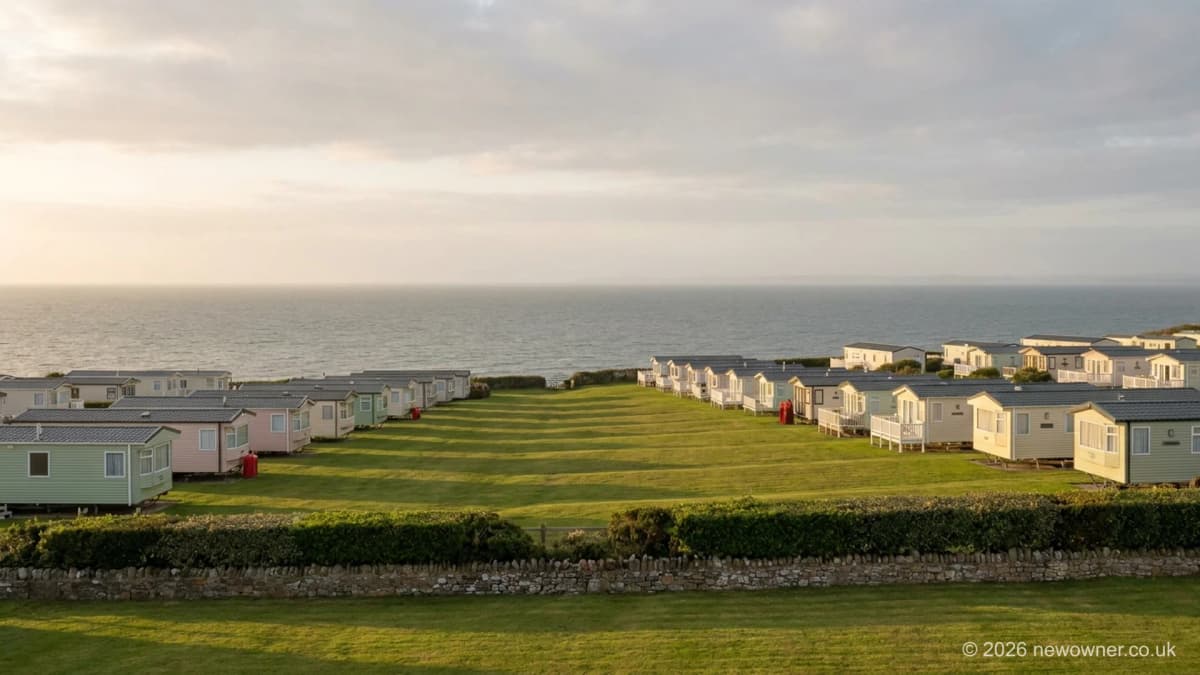
UK holiday parks are priced per pitch, and a static caravan pitch averaged £34,192 in 2024.
The market you are buying into
A caravan park for sale is one of the few small businesses where the asset and the trade are genuinely inseparable. You are buying land, a licence, an income stream and a community of owners who will still be there on your first morning. Get any one of those wrong and the other three stop mattering.
Start with scale, because it is easy to underestimate. Research by Frontline Consultants for the UK Caravan and Camping Alliance put the gross direct visitor expenditure impact of the UK holiday park and campsite sector at £12.2bn in 2022/23, equivalent to £7.2bn in gross value added and 226,745 full-time equivalent jobs. The same study found that park and campsite visitors stayed 82% longer and spent 12% more than the UK tourism average, which is the number that should interest you most as a buyer. Long stays are what turn a seasonal site into a business with predictable cash.
The buying market has been unusually candid about itself lately. Christie and Co advised on £716m of leisure businesses during 2025 and logged more than 1,300 new web enquiries from prospective buyers, but described the year as a buyer's market with a wide range of offers being tabled and operators being selective about which parks fitted their portfolios. Translated: there is demand, it is discriminating, and asking prices are being tested.
What a caravan park for sale actually costs
Parks are priced per pitch far more often than they are priced on a multiple of profit. It is a crude metric, and it is also the one the market actually uses, because it lets buyers compare a 40-pitch site in Norfolk with a 300-pitch site in Cornwall without unpicking two very different sets of accounts.
The most recent published series comes from Savills, whose Holiday and Home Park Update 2025 tracked average transaction values through 2024.
Three things are worth pulling out of that chart.
The fall is real but it followed a boom. Holiday static caravan parks peaked at £42,598 per pitch in 2023 and settled at £34,192 in 2024. Savills is explicit that 2024 prices remain well above pre-pandemic levels, so this is a correction rather than a collapse. Anyone quoting you 2023 comparables is quoting the top of the market.
Transactional data lags operations. Savills makes the point directly: deals recorded in 2024 were largely negotiated during the period when the Bank rate sat at 5.25%, before it fell to 4.75%. If a park's trading has improved since, the comparables will understate it. If trading has weakened, they flatter it.
Touring pitches are being converted. Site inspections in 2024 found touring pitches being replaced with static caravan pitches, and Savills reported seasonal touring fees rising to a level in many cases comparable with static pitch fees. A touring park with room to convert is the value play in this sector, which is precisely why Savills describes touring parks with residential conversion potential as the most coveted and rarest assets.
Do not price a park on turnover
The gap between a park's turnover and its sustainable profit is wider than in almost any other small business, for a reason covered in the next section. If you want to sanity-check a valuation on earnings rather than pitches, our guide to normalised EBITDA explains the adjustments, and the 2026 multiples data gives you the wider UK context for what small businesses are currently changing hands for.
Read the income before you read the price
Every caravan park has at least three income streams and they behave completely differently. Sellers rarely separate them for you. Do it yourself before you go anywhere near an offer.
Pitch fees. Annual licence fees paid by caravan owners for the right to keep a unit on site. This is the recurring, predictable, valuable income, and it is what a buyer is really acquiring. It usually renews on the same date each year, which means the timing of your completion determines whether you or the seller banks a full year of it.
Caravan sales. Margin on selling new and used static units to incoming owners. This can be the largest line in the profit and loss account and it is the least reliable. It depends on stock availability, finance rates, manufacturer terms and the park's ability to keep churning older units off site. A park that made most of its money selling caravans in a good year is not the same business as a park with the same profit made from pitch fees.
Everything else. Bar, cafe, shop, launderette, amusements, holiday letting fleet, seasonal touring. Margins vary enormously and staffing costs are heavy. Savills noted operators scaling back staffing-intensive operations such as bars, cafes and letting fleets in response to cost pressure, so check whether a facility you are being shown as an asset is actually being run at a loss.
The questions that separate the three
Ask for a pitch-by-pitch schedule showing fee, renewal date, owner name and the age of the unit. Ask for caravan sales volumes and gross margins for at least three years, split new and used. Ask how many units are over twenty years old, because parks typically impose an age limit and a cluster of ageing vans is a wave of forced sales or forced departures coming at you.
Then ask the question sellers dislike: how many pitches were empty at the start of the last three seasons. Occupancy of licensed pitches is the single number that predicts next year's revenue, and it is the one most likely to be presented as a snapshot from the best week of the year. Our due diligence checklist covers the paperwork discipline that keeps this honest.
The site licence is the business
This is the section that catches out buyers coming from other sectors. A caravan park cannot lawfully operate without a site licence issued by the local authority under the Caravan Sites and Control of Development Act 1960, and that licence sits on top of planning permission rather than replacing it. Two separate consents, two separate risks.
What matters to you as a buyer:
The licence conditions cap what you can do. Licences specify the maximum number of caravans, their spacing, fire safety provisions, road widths and often the months of the year the site may be occupied. A park advertising 120 pitches whose licence permits 90 is selling you a problem, not an opportunity.
The season is written down. Many holiday park licences and planning consents restrict occupation to a defined season, and some prohibit anyone using a unit as a sole or main residence. If the seller's income assumes twelve-month occupancy and the consent says ten, the surplus is not income you are buying.
Residential parks are a different legal animal. Parks with permanent residents fall under the Mobile Homes Act regime, which governs pitch agreements, pitch fee reviews and what happens when a resident sells their home. The economics, the obligations and the buyer pool are all distinct from holiday parks. Do not treat the two as interchangeable because they look similar from the entrance.
Ask to see the licence, not a summary of it. Then read every condition against what you saw on site. Unauthorised hardstandings, extra pitches squeezed into a corner, a shower block that was never in the plans: these turn up regularly, and they become your enforcement problem the day you complete.
Because so much of the value sits in land and consents, most caravan park deals are structured around the freehold. Our guide to buying a freehold business covers what that changes about funding and negotiation, and if the site comes with holiday letting units you may also want the holiday let business guide.
Due diligence that is specific to parks
The generic checklist applies, and there is a park-shaped layer on top of it.
Walk the site with the licence in your hand. Count pitches. Check spacing. Look at the state of the roads, the electrical hook-ups and the water and drainage. Utilities on parks are frequently private, ageing and expensive, and a private sewage treatment plant nearing end of life is a five- or six-figure surprise.
Check the owner agreements. How long do they run? What notice provisions exist? Is there a commission clause on private sales of caravans between owners, and is the park actually enforcing it? Commission on owner-to-owner sales is real income and it is often undocumented.
Verify the flood position. A meaningful share of UK parks sit on river floodplains or coastal land. Check the Environment Agency flood map, then check what the insurers say, because those are two different answers. Insurance quotes obtained in your own name are worth more than the seller's renewal notice.
Understand the caravan stock on site. Are any units owned by the business rather than by residents? Are any subject to finance? Is there a letting fleet, and if so, who owns the vans and what condition are they in?
Get the rateable value and the utilities contracts. Parks are heavy energy users. A contract fixed at 2022 rates that expires three months after completion changes your first-year numbers materially.
For the wider process, from first enquiry to completion, start with how to buy a business in the UK and the questions to ask a seller.
Funding and timing
Parks are property-backed, which helps. They are also specialist trading businesses, which does not. Most high street lenders route these to a commercial or leisure team, and the deal is assessed on the land value and the sustainability of pitch fee income rather than on last year's headline profit.
Expect to be asked for a proper valuation by a surveyor who does parks, not general commercial property. Expect the lender to discount caravan sales margin heavily or exclude it. Expect a deposit requirement at the higher end of the normal range.
On timing, Christie and Co's own transaction data across all the sectors it covers puts the average deal at around seven months from acceptance of an offer to completion, with hospitality and childcare closer to five months and regulated sectors running to seven to ten. Park deals sit in the slower half of that range because of the licence and planning work involved. Budget accordingly, and do not give notice on anything until contracts are exchanged.
Our guide to financing a business purchase covers the lender conversation, and debt and liabilities covers what you inherit if you buy the company rather than the assets.
How to actually find one
Any caravan park for sale in the UK comes to market through a narrow set of channels, and a large share never reach a public listing at all. Specialist agents hold quiet mandates for months because sellers do not want residents and staff finding out from a website.
That has two implications. First, register with the specialists as well as the marketplaces, and be specific about size, region and price so they can match you rather than mailshot you. Second, be ready to move when something appears, because the good sites are viewed within days.
You can browse businesses for sale on NewOwner and filter by sector and region. If you are still deciding between park types and other property-backed trades, the self storage guide covers a sector with a similar land-plus-income profile but a very different operating model.
If you own a park and are thinking about the other side of this transaction, our guide to selling a business sets out what preparation actually moves the price.
The honest summary
Caravan parks reward operators who like fixing things and dislike surprises. The income is more predictable than most small businesses because pitch fees renew, the asset is real, and staycation demand has held up. Against that, the regulatory surface is wide, capital expenditure is lumpy and unglamorous, and the accounts routinely mix a reliable annuity with a volatile trading margin in a way that flatters the whole.
Prices came off their 2023 peak and have not returned to pre-pandemic levels. That is a reasonable place to buy if you know what you are buying. Price the pitch fees, treat the caravan sales margin as a bonus, read the licence twice, and get the survey done by somebody who has seen a park before.
Ready to sell your business?
Get Started