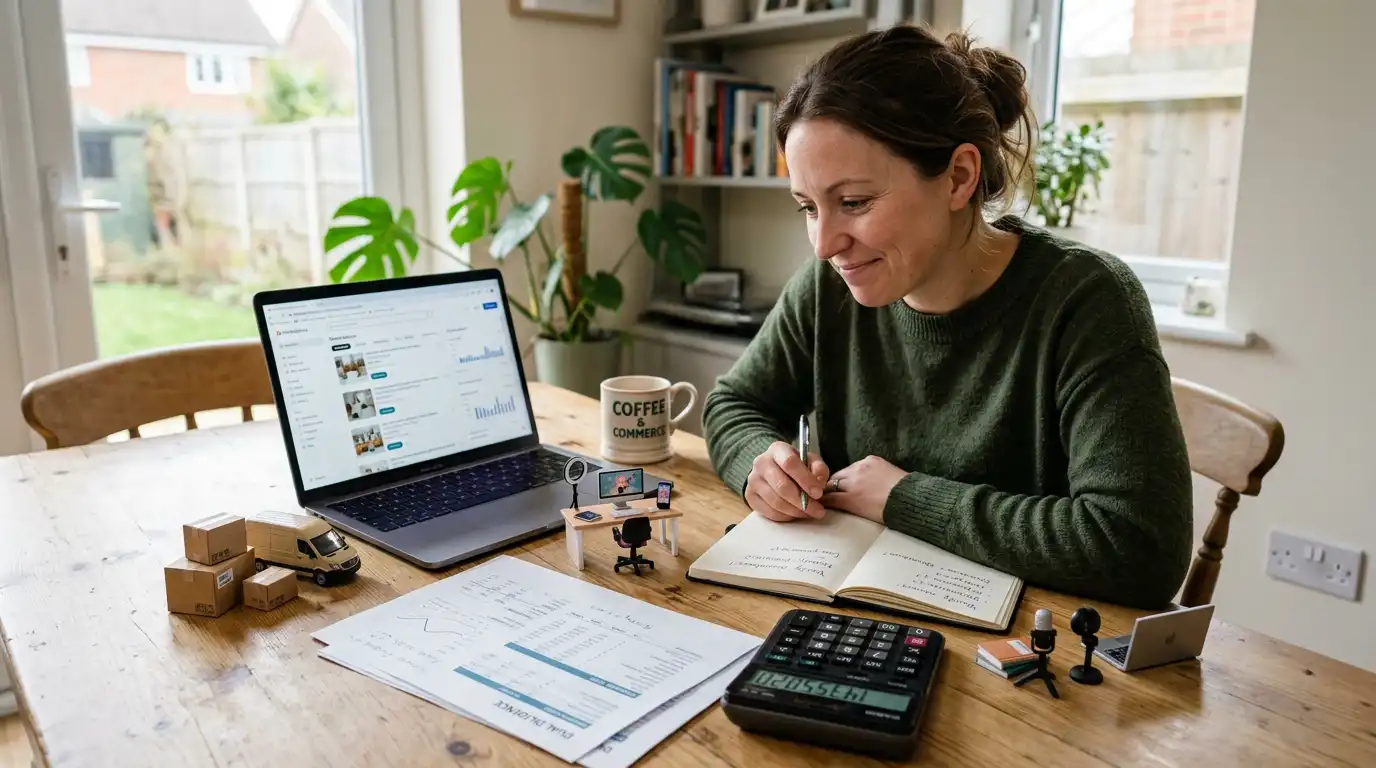
A home-based business for sale UK buyers consider is rarely the office-job-replacement everyone hopes for. Most of what's listed is one of three things: a small e-commerce brand, a small content or affiliate site, or a freelancer's book of business looking for a buyer. Each has different economics, different risks, and very different post-acquisition realities.
I've reviewed dozens of UK home-based and online businesses in the last 18 months. The strong ones share patterns. The weak ones share other patterns. This piece is what to look for if you want a business you can run from a spare bedroom in 2026 without learning the hard way which ones are unbuyable.
If you want to browse live deals, filter the NewOwner marketplace by Home-based & Online. For the rest of this guide, I'll walk through what's actually worth buying and what to leave on the shelf.
Why the home-based market changed
Three things shifted between 2019 and 2026 that matter to UK buyers.
Remote-friendly tools (Slack, Notion, Stripe, Shopify, Cloudflare) are now mature enough that one person can run a £200K-£600K turnover online business from a desk with no employees and no premises. That wasn't true in 2015.
Second, customer acquisition costs on Meta and Google have risen sharply. A Shopify store that was profitable in 2020 on £8 customer acquisition cost may be break-even in 2026 at £15. Buying a profitable business is now meaningfully easier than building one from scratch.
Third, the supply side of online businesses for sale has matured. Marketplaces like NewOwner, Flippa, and Empire Flippers list thousands of deals. Pricing is more transparent than five years ago. Trade publications and brokers track average multiples and aging metrics openly.
The net result: a 2026 buyer with £30K-£200K of equity has a real choice of UK home-based businesses with verified financials, transferable infrastructure, and asking prices the seller has put thought into.
Categories of home-based business for sale in the UK
Five categories make up most of the UK home-based-for-sale market.
Small e-commerce (Shopify, Amazon FBA, Etsy)
Product brands with £100K-£800K annual revenue. Owner ships from a third-party logistics provider (3PL) or, increasingly, from Amazon FBA warehouses. Typical asking 2-4x annual net profit. The good ones have a defensible niche, a repeat-purchase rate above 20%, and at least 12 months of consistent margin. The bad ones are dropshipping operations with no inventory, no brand defensibility, and CAC running ahead of LTV.
Content and affiliate sites
WordPress sites monetised through display ads (Mediavine, Ezoic, AdThrive) and affiliate commissions (Amazon Associates, niche programmes). Asking prices 30-45x monthly net profit. The strong ones have organic traffic from search, diversified content topics, and clear editorial standards. The weak ones depend on one or two pages for 80% of revenue.
Newsletters and small media
Subscriber-list businesses (Substack, beehiiv, ConvertKit). Typically 3-5K paid subscribers at £5-£15/month. Asking 24-36x monthly net revenue. Defensibility is the editorial voice and the subscriber relationship, which is harder to transfer than a Shopify store.
Small SaaS and digital products
Micro-SaaS businesses (£50K-£500K ARR). Often built and run by one developer. Multiples 3-6x ARR depending on growth, churn and tech stack. The strong ones have low churn, recurring billing through Stripe, and a clear product-market fit. The weak ones have one or two large customers driving most revenue.
Service businesses with productised offers
Freelance design agencies, copywriting practices, SEO consultancies, virtual assistant agencies. Asking prices 1-2x annual profit because the value sits in the owner's relationships. Strong ones have systemised processes, contractor teams, and recurring client retainers. Weak ones are essentially the owner's job dressed up as a business.
What to verify before you offer
The checks that matter for UK home-based businesses look different from physical-business due diligence. Specifically:
- Revenue source. Pull at least 12 months of payment-processor statements (Stripe, PayPal, Shopify Payments, Amazon Seller Central). Compare to bank deposits. Compare to the seller's filed accounts. If the three don't reconcile, walk away.
- Traffic source. For content sites and e-commerce, look at Google Analytics over 24 months. Verify the seller's analytics by checking aggregator data (SimilarWeb, Ahrefs). Sudden traffic spikes followed by declines often mean the seller bought traffic to inflate sale-time numbers.
- Customer or subscriber list. For SaaS, newsletters and e-commerce: when was the list grown? What's the open rate and engagement trend? A list grown rapidly in the last 6 months is suspect.
- Platform dependency. Amazon FBA businesses can be terminated by Amazon with limited notice. A Shopify store with a custom theme is portable. An Etsy store is entirely platform-dependent. Price accordingly.
- Intellectual property. Is the trademark registered with the UKIPO and in transferable name? Are domain registrations in the company name or the founder's personal name? Trademark and domain transfers should be in writing in the SPA.
- Supplier and 3PL relationships. Are supplier contracts transferable? Will the 3PL accept a new account holder without renegotiation? Most do, but get it in writing before exchange.
- Tax compliance. UK VAT registration, MTD compliance, overseas VAT collection (especially Amazon FBA across EU/US). Buyers commonly inherit historical tax exposure they didn't price in.
For a broader operational due diligence checklist, see the how to analyse a business before buying guide.
What home-based businesses actually cost
Realistic 2026 asking-price ranges by category:
- Shopify e-commerce brand, £200K-£500K turnover. Asking £80K-£250K (2-4x annual net profit).
- Amazon FBA private-label brand, £300K-£700K turnover. Asking £150K-£400K (2.5-3.5x annual net profit).
- Content site, £50K-£150K annual revenue. Asking £150K-£450K (30-45x monthly profit).
- Newsletter, 3-5K paid subs at £10/month. Asking £75K-£200K (24-36x monthly revenue).
- Micro-SaaS, £100K-£300K ARR. Asking £200K-£900K (2-3x ARR for stable, more for growth).
- Productised service business, £100K-£250K profit. Asking £80K-£300K (1-2x annual profit).
These ranges reflect average UK deals in early 2026. Specific deals vary by growth rate, customer concentration, churn and platform risk.
For a like-for-like comparison of sector-by-sector ROI across UK SME categories, see the best small businesses to buy in the UK in 2026 guide.
Common mistakes home-based business buyers make
The pattern I see most often:
Buying without understanding the work. A profitable Shopify store still needs daily customer support, marketing decisions, inventory planning. Buyers who assume "online means passive" tend to lose interest in months 3-6 and the revenue starts drifting.
Overpaying for traffic that depends on one channel. A content site getting 95% of visits from Google search is one algorithm update away from a 60% revenue drop. Pay for diversified traffic, not concentrated traffic.
Ignoring tax exposure. Amazon FBA businesses operating across EU, US and UK warehouses pick up VAT and sales-tax exposure that the seller may not have managed properly. Always check the last 4 years of VAT positions with a specialist accountant.
Underestimating platform risk. Etsy can suspend a shop. Amazon can ban a seller. Meta can ban an ad account. None of these get reversed quickly. Price the risk in.
Buying an asset masquerading as a business. A productised service is a business only if the systems, contractors and client relationships transfer. If everything sits in the founder's head, you're buying a job, not a business.
How to find good home-based businesses for sale
Sources for UK home-based and online deal flow:
- Direct marketplaces. Home-based and online business listings on NewOwner. Verified sellers, direct contact.
- International marketplaces. Flippa and Empire Flippers list global online businesses including UK-domiciled ones. Empire Flippers is better for the £100K+ end, Flippa for sub-£50K.
- Acquire.com. Strong for micro-SaaS and small B2B tools.
- MicroAcquire and IndieMaker. Niche venues for solo-founder SaaS exits.
- Direct outreach. If you've identified a specific creator, publisher or shop owner, asking directly often works. Many solo founders are quietly tired and would consider an offer if it came in clean.
For the broader UK acquisition framework that applies whether the business is home-based or has premises, the step-by-step UK buyer's guide for 2026 is the place to start. For investor perspectives on this category, the 10 best UK small business investment opportunities for 2026 covers e-commerce DTC and SaaS as sectors with the best risk-adjusted entry economics.
Ready to sell your business?
Get Started